Planet of the Apes destroys the American Cynic

planet of the apes

What does it mean to be a cynic when there’s no world left to not believe in? This is the question at the core of 1968’s Planet of the Apes. This is by no means the only theme as racism, classism, ageism, and probably various other isms as well are abundant. Not to mention the timeless religion vs science argument combined with Cold War fear of nuclear annihilation. These are all important, but they’ve also been tackled elsewhere over the years as I’m four and a half decades late to this subject This film, in addition to all these other things, represents the end of both American idealism and the American cynic, and both of these are accomplished solely through the protagonist Taylor.

We all know the scene, right? A long shot of a single horse carrying two passengers trots along the coastline with waves crashing down and water running up towards its legs. The camera shifts slightly and suddenly obstructing our view is something eerily familiar, yet somehow we can’t quite place it, but it still fills us with a sense of dread. Finally, our hero Taylor (Charlton Heston) drops from the horse and stands before this rusted, seaweed covered object still kept in obscurity. First he stands in shock. “Oh my god, I’m back. I’m home.” Then he collapses and, in an overacting masterpiece that only Charlton Heston could pull off, shouts at his deceased ancestors: “You Maniacs! You blew it up! Damn you, God Damn you all to Hell!” The camera pans out and we see what he sees. It’s the Statue of Liberty. Holy shit. And scene.

Great twist ending, right? Not really, at least not if the twist is simply meant to shock and surprise. It’s not much of a gotcha, because I think, if we’re honest with ourselves, we all kind of saw that one coming. Maybe not the Statue of Liberty specifically but we at least suspected we were indeed on Earth all along. The real twist is in the fact that Taylor, who has already accepted that everyone he’s ever known and loved is gone, that his species, in all likelihood, time has past, is utterly destroyed by the reality of it all.

Let’s start with Taylor and who he is. He is disgusted with Earth and what humanity has become. His last words to the world he thinks he’s leaving behind are “Does man, that marvel of the universe, that glorious paradox who sent me to the stars, still make war against his brother? Keep his neighbor’s children starving?” This is a man who laughs maniacally when his companion plants an American flag in the soil of this new planet they’ve landed on. He mocks any idealism and anyone who dares to dream about Earth. He waxes philosophically with lines like “I’m a seeker too. But my dreams aren’t like yours. I can’t help thinking that somewhere in the universe there has to be something better than man. Has to be.” This is a man who has gleefully left his home world and cares nothing for those he left behind. He doesn’t identify himself as an American and only begrudgingly acknowledges his Earthling origins.

A shift, though, starts to happen in Taylor. When he’s forced to fight for his survival against the apes, he begins to sugarcoat humanity. He tells Dr Zaius, upon finding archaeological evidence of humans that predate apes, “He was a weak, fragile animal, but he was here before you were. And he was better than you are.” So why is he suddenly drinking the human Kool-aid? Because he’s now faced with the harsh reality that he’s a minority. He’s hated, and feared. His very existence is a threat to the establishment, to the culture. People like that can’t afford to be cynics. But look at his face when Dr Zaius tells him “You are right, I have always known about man. From the evidence, I believe his wisdom must walk hand and hand with his idiocy. His emotions must rule his brain. He must be a warlike creature who gives battle to everything around him, even himself.” He covers it up quickly, but there’s a flash of recognition, that Dr. Zaius is right. All the reasons Taylor left Earth come back to him, but he’s now too stubborn to admit it. Nothing in the Orangutan’s words are particularly new, we heard Taylor say similar things the entire first third of the film. Hell, Zaius practically tells him he’s on Earth but Taylor refuses to acknowledge it.

So then we get to the big scene. Taylor on his knees, cursing mankind, destroyed. The commentary on the dangers of nuclear warfare is not subtle, but the notion of national identity is. Taylor’s rejection of America is his identity, because he feels he’s better than his countrymen, that he’s evolved beyond them. But when faced with their demise, when it becomes irrefutable that we’ve destroyed ourselves, he hates them and weeps for them. He lost his world, his identity, and his humanity all in one instant.

Couldn’t find the video to embed, but for those of you would like to watch the ending, whether you have never seen it (shame on you) or just feel like watching it again, here it is.
https://www.facebook.com/video/video.php?v=1064577264634

Gravity

gravity

Directed by Alfonso Cuaron
Starring Sandra Bullock and George Clooney

Grade: A

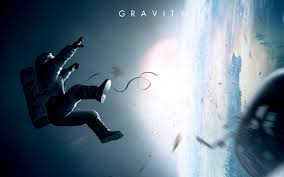
Gravity is about life and death, birth and rebirth, and isolation and community. It’s also about the visceral fear of survival in an environment that doesn’t permit life. This film, directed by Alfonso Cuaron, succeeds in both stated objectives, entertainment and subtext are both given equal attention. I imagine the physics can be picked apart, though the science felt very real and plausible to me, but if you’re focusing on the believability of a movie set in space then I would suggest you’re doing yourself a disservice. Gravity is not interested in being the most accurate scientific movie of all time, though it takes care to make it passable, it’s goal is to thrill the audience and remind that even we’re literally cut off from the world and surrounded by millions of miles of emptiness, we’re never truly alone. The lack of cynicism in this movie, without passing into sentimentality, is its greatest achievement.

The plot is simple. There is an accident on a satellite and Doctor Ryan Stone (Sandra Bullock), on her first trip to the space, is cast off into space along with seasoned veteran Matt Kowalski (George Clooney) and together they must survive and make it back to Earth. In some ways, I suppose, it’s Open Water set in space, though there are no space sharks (new movie idea: Space Sharks!). They’re forced to use their limited resources and fall back on every small piece of training they received in order to get home. Obviously, there are many setbacks and hardships along the way. A lesser movie would be mostly concerned with awesome looking set pieces and visual graphics, while offering a foregone conclusion of their safe return, but Gravity actually cares about whether they survive or not and each set piece is constructed with that in mind.

George Clooney has recently made a string of movies, namely The American and Up in the Air, where the lesson the protagonist learns is that no man is an island, that people need people, or as Ryan Bingham says in the latter movie: “Life is better with company.” Those movies, though, have a cynical edge in that the lesson is learned but too late to do anything about it. Gravity has the same lesson but doesn’t seem to suggest it’s ever too late to learn such a thing (whether they survive or not is not relevant to this lesson and you’ll get no spoilers from me as to the outcome of that). The final shot of this movie is gorgeous and life-affirming and all that shit I usually hate but it’s done so well here that I’m completely sold.

Sandra Bullock brings fear and a quiet desperation to this role. As Doctor Ryan Stone, a name that is representative of both man and woman, and yes she represents all of us, she is a grieving mother, who lost her daughter to an unfortunate and simple accident. She has severed all ties to the world and, both literally and figuratively, and doesn’t really seem to care whether she lives or dies. This is until, of course, she is actually faced with death and must confront all that it means to live and to die. Maybe it’s a simple plot device, force a miserable person to fight for their life and thus teach them to live, I mean it’s been done a shit ton of times, sure, but it works so well here that it feels new and fresh despite the cliché. I don’t know that Bullock or Clooney deserve any acting awards for these performances, the movie itself seems like the star to me, but Bullock in particular, who I usually am not a huge fan of, brings her A game and sells the role to near perfection. There are a couple of cringe worthy lines of dialogue and a very heavy handed scene where she resembles a fetus in a womb, but they are small gripes overall. Clooney, meanwhile, brings his usual sleazy charm that provides levity and experience, and Stone’s last chance at a human connection.

See this movie in IMAX if you can. I couldn’t because apparently the greater Phoenix area would rather play Elysium in its IMAX theaters rather than a space epic, but I did see it in 3D and thought for once it added a worthy element to the movie, rather than just looking vaguely cool. The depth of space seems more infinite and terrifying and wonderful in three dimensions. I was so engrossed by the end of this film that I walked out to my car still wearing my 3D glasses. I probably looked like an idiot, but I feel that proves how good this movie was, and I’m pretty used to looking like an idiot, so no big deal.

The Mirage by Matt Ruff

mirage-by-matt-ruff-final-cover

Grade: C

At this point, September 11th stories have practically become their own genre. We have Sci-Fi, Horror, Mystery, Appalachaian Lesbian, and 9/11 stories. The idea, I suppose, is that those attacks will conjure up enough emotional memory in the audience that the impact of the story will be that much greater. It’s a pretty cheap tactic, one that I can’t think of a single instance where it felt honest and not manipulative. Matt Ruff uses this new genre, along with the tried and tested Sci-Fi branch off The Alternate Universe, in his novel The Mirage.

In this novel, the alternate reality is that on November 9th (get it? 11/9?) a group of Christian extremists from the third world region of America hijack some planes and fly them into the twin towers of the United Arab States. Basically, the same thing happens, in reverse though, as happened in real life. The United Arab States declares a war on terror and bombs the shit out of America and frees them from their vicious tyrant, though all their efforts don’t really seem to stop the terrorist attacks, or make the war-torn region any safer. There are three main characters: Mustafa, the morally conflicted one who senses something is amiss about his world, Samir, the closeted homosexual, and Amal, the tough woman playing in a man’s world. Sound familiar? That’s because those are character tropes used in nearly every spy thriller ever written.

Anyway, those characters aren’t important. The ones the reader will flock to are Osama Bin Laden, Saddam Hussein, an unnamed but very clearly Dick Cheney, and a bunch of other people from our reality. What could have been fun about this world would be to make well known villains, like those listed above, into something heroic, or at least a conflicted source of good. Unfortunately Ruff is not interested in that. “A wicked prince in one world is a wicked prince in all worlds” is the sentiment used to justify keeping the villains as villains, and to be fair there is a plot reveal that justifies it dramatically as well. Still, I suspect the real reason is that the author, and maybe the publisher, doesn’t think the American public can tolerate Hussein or Bin Laden as anything but monsters. It feels like an opportunity for genuine and clever satire gone completely to waste.

I don’t mean to completely shit on this book though. It’s a perfectly serviceable espionage thriller, with a pretty exciting plot and well-written action. The characters may be a bit incomplete and feel like caricature at times, but that’s pretty true of the genre as a whole. The plot twists and battle scenes are what’s important in these works, not deep character insights. If it didn’t use 9/11 as a cheap way to add meaning to an otherwise perfectly fine, if unremarkable, story, I would probably grade it a bit higher. As it is, I’m not sure what this book has to say about the turmoil the world has been over the past decade-plus that hasn’t already been said. It doesn’t bring anything new to the conversation, it just makes us go “Oh, that’s George Bush they’re talking about!” Or “Holy shit, is that really Timothy McVeigh?” Merely employing the existence of these characters isn’t enough to tell a impactful story with them.

Please don’t read anything political into this review, or this book for that matter. This novel is neither Liberal propaganda, nor Conservative. Ruff is equally critical of both sides and never loses his sense of hope for a possible future. This story ends ambiguously, but optimistic in its way. Those looking for political, cultural, or philosophical insights will find it lacking. But those looking for some glimmer of hope through the shit cloud of crippling despair fed to us through the media outlets and the politicians we keep electing for some reason, might just find a reason to maintain some shred of hope in humanity.


Buy this book!

A Maze of Death by Philip K Dick

a maze of death

Grade: B+

Science fiction at its best plays with our fears and anxieties and flips them into a plot about robots and space and crazy technology so we can process everything safely. The genre lightens its social commentary into something that, ideally, entertains as well as challenges preconceived norms. The dystopia convention, for instance, works so well because we’re all scared of some “perfect” society where our freedoms and identities are taken away in order to maintain the guise of perfection. The fears are prevalent, just look at the current fears of Obamacare, or the gay marriage issue, or go back a few years and look at the reaction to the Patriot Act. The passionate reaction comes from the idea that the powers that be are setting up their own society and pulling us all with them, while leaving our true selves behind. This dread and distrust of authority is consistent in any good science fiction story. Philip K Dick is often considered one of the masters of the genre, both in terms of talent and output. Even if you’ve never read him, you’ve seen movies based on his writing, either loosely or directly. I am a newcomer to him, and Maze of Death is in fact the first novel by Dick that I’ve read. This particular book sort of ushers in his later years, where he became much more spiritual in his writing. The transition is evident, if crude, as he wrestles with all kinds of questions of god and faith, and the role they play the universe.

The story follows Seth Morley, mainly, and a cast of other characters called to work on Delmak-O for reasons that are not made clear to any of them. Morley is happy though because he prayed for a transfer and is content with the notion that his prayers have been answered. In this reality, deities are accessible via prayer transmitters and are a physical presence in the universe. Once on this seemingly uninhabited planet, the new residents don’t find it too welcoming. In the now familiar trope, they are trapped on an unfamiliar area with a malevolent force killing them off one by one, or at least they assume it’s a malevolent force, the one their beliefs call the form-destroyer. The characters rely on their faith and individual intelligences to attempt to band together and stay alive and hopefully escape the planet. If you know anything about science fiction, you know there’s a twist, and you probably know that the twist somehow involves the twisted nature of man rather than some god-being with a grudge against his creations. The twist is fun, but it’s not really the most important part of the book. The theme that is most significant is the idea that, on this world, for whatever reason, God has abandoned these people, and the truly special part of this book is the wrestling match these characters have with their faith and their loyalty and duty to each other. Dick, in his early spiritual journey, seems to have trouble believing that man, left to his own devices, is capable of surviving. In fact, beyond even that, he seems to suggest that without God, man will resort to murder and abandonment of his humanity.

Dick writes in a simple, but articulate style. Though he seems to have a basic understanding of it, he’s not interested in bogging the reader down with the nature of the technology this universe possesses, just that it works. I find it refreshing that there are no long passages over-explaining the various concepts that might seem foreign to us because we don’t live in a society that has mastered space travel. These people can travel across galaxies, we can’t. Good, got it. What this allows him to do, is to focus on the story and make the action accessible without detracting from the believability. The same logic is followed with the characters. None of them are developed too much, though I’m glad he resisted the urge to paint them as caricatures since he’ll be killing most of them off anyway, and are given just enough personality to move the plot forward. This is not a character study, this is a meditation on man’s relationship with God and needs to keep the action constantly moving in order to achieve its goals. Normally, I would be slightly irritated at the lack of character development but here it feels natural, after all if his thesis is that man is defined by his relationship with the divine, then painting fairly hollow characters makes complete sense.

This being my first Philip K Dick novel, I feel I’ve finally earned the right to stand among the ranks of the nerds. My new plan is to read two of his novels every year for the rest of my life. There’s like 46 of them or something, so assuming I don’t live an annoying long time, this should keep me occupied.

Note: This novel was originally published in 1971 and is currently out of print. It is due to be re-released on April 16. If you want to read it, I recommend you go to your local used bookstore, or preorder it from this website.


Preorder this Book!