The Mirage by Matt Ruff

mirage-by-matt-ruff-final-cover

Grade: C

At this point, September 11th stories have practically become their own genre. We have Sci-Fi, Horror, Mystery, Appalachaian Lesbian, and 9/11 stories. The idea, I suppose, is that those attacks will conjure up enough emotional memory in the audience that the impact of the story will be that much greater. It’s a pretty cheap tactic, one that I can’t think of a single instance where it felt honest and not manipulative. Matt Ruff uses this new genre, along with the tried and tested Sci-Fi branch off The Alternate Universe, in his novel The Mirage.

In this novel, the alternate reality is that on November 9th (get it? 11/9?) a group of Christian extremists from the third world region of America hijack some planes and fly them into the twin towers of the United Arab States. Basically, the same thing happens, in reverse though, as happened in real life. The United Arab States declares a war on terror and bombs the shit out of America and frees them from their vicious tyrant, though all their efforts don’t really seem to stop the terrorist attacks, or make the war-torn region any safer. There are three main characters: Mustafa, the morally conflicted one who senses something is amiss about his world, Samir, the closeted homosexual, and Amal, the tough woman playing in a man’s world. Sound familiar? That’s because those are character tropes used in nearly every spy thriller ever written.

Anyway, those characters aren’t important. The ones the reader will flock to are Osama Bin Laden, Saddam Hussein, an unnamed but very clearly Dick Cheney, and a bunch of other people from our reality. What could have been fun about this world would be to make well known villains, like those listed above, into something heroic, or at least a conflicted source of good. Unfortunately Ruff is not interested in that. “A wicked prince in one world is a wicked prince in all worlds” is the sentiment used to justify keeping the villains as villains, and to be fair there is a plot reveal that justifies it dramatically as well. Still, I suspect the real reason is that the author, and maybe the publisher, doesn’t think the American public can tolerate Hussein or Bin Laden as anything but monsters. It feels like an opportunity for genuine and clever satire gone completely to waste.

I don’t mean to completely shit on this book though. It’s a perfectly serviceable espionage thriller, with a pretty exciting plot and well-written action. The characters may be a bit incomplete and feel like caricature at times, but that’s pretty true of the genre as a whole. The plot twists and battle scenes are what’s important in these works, not deep character insights. If it didn’t use 9/11 as a cheap way to add meaning to an otherwise perfectly fine, if unremarkable, story, I would probably grade it a bit higher. As it is, I’m not sure what this book has to say about the turmoil the world has been over the past decade-plus that hasn’t already been said. It doesn’t bring anything new to the conversation, it just makes us go “Oh, that’s George Bush they’re talking about!” Or “Holy shit, is that really Timothy McVeigh?” Merely employing the existence of these characters isn’t enough to tell a impactful story with them.

Please don’t read anything political into this review, or this book for that matter. This novel is neither Liberal propaganda, nor Conservative. Ruff is equally critical of both sides and never loses his sense of hope for a possible future. This story ends ambiguously, but optimistic in its way. Those looking for political, cultural, or philosophical insights will find it lacking. But those looking for some glimmer of hope through the shit cloud of crippling despair fed to us through the media outlets and the politicians we keep electing for some reason, might just find a reason to maintain some shred of hope in humanity.

Buy this book!

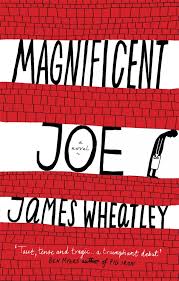
Magnificent Joe by James Wheatley

magnificent joe

Grade: A-

Centering a novel’s or a movie’s action around a mentally challenged person is inherently dangerous territory. The story quickly turns into Radio or something similar, that is to say overly simplistic sentimental bullshit meant to pull on heart strings and manipulate its way into relevancy. The lesson is, you see, that this “slow” human being is really the wisest sage among us and exists for the sole reason of teaching us all valuable lessons on life and allows us a glimpse, for once, into our own humanity. These selfless beings are our guardian angels, not actual, fully realized people with their own fears and ambitions and dreams and desires. Nope, the mentally challenged are normally relegated to the same proverbial corner that the Magical Negro has been stuck in since, well forever more or less. I bring this up because Magnificent Joe by James Wheatley, refreshingly, doesn’t do that. Joe is a fifty year old man with learning difficulties and that’s who he stays as for the entire book. He doesn’t suddenly break out of character to deliver key advice at a crucial time. He’s stuck in his own rut, that is in the process of being destroyed, the same as all the other characters in the novel. They’re all of them limited in life, Joe’s just another number among them.

The narrator, with the exception of a few chapters told in the third person, is Jim. Jim spent most of his teenage years and the first few of his adult years locked up for killing another kid in a fight. It wasn’t an intentional thing, just a lucky, or unlucky, punch that he landed. When he gets out he goes back to the same small town he grew up in, his family all dead, and is taken in by his old friends. With no options for an ex-con, he goes to work in construction with his buddies and ekes out a meager existence. In some vain attempt to atone for his sins, he takes up his father’s old role of caring for Mrs. Joe, an old widow and the mother of the title character. He lives basically in squalor, spending all his available cash on booze and spends most of his free time at the pub with his friends, Barry and Geoff. Through carefully guarded secrets, betrayal of friends, and an impactful death, the small town becomes even smaller, more restrictive and far more dangerous. The story exists for Jim to be redeemed, more or less, but it doesn’t let him off easy. Wheatley is perfectly content dragging this man through every gutter he can find, destroying him physically, mentally, spiritually and emotionally, until Jim is a broken man and has a chance to be rebuilt.

Written in stripped down, unpretentious language, Magnificent Joe feels authentic. Wheatley’s ear for dialogue is damn near pitch-perfect and his prose doesn’t waste time on flowery descriptions or rambling, abstract interior monologues. The only real flaw in this novel is that the end feels a bit rushed. It’s not exactly easy, but it wraps everything up very quickly. I greatly appreciate short novels and find the longer ones to be a little off-putting, but these characters are complex and enjoyable enough to warrant spending another 20 pages or so with them. The last chapter in particular feels very much tacked on just so we can get some semblance of a happy ending. In a novel that avoids the cliché very well throughout, for it to succumb to a tried and true, and a bit trite, image to end on was a bit insulting. Still, this is a very solid debut and worthy of a read. Wheatley’s a strong new voice and a talent that should definitely be watched.


Buy this book!

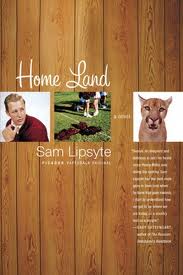
Home Land by Sam Lipsyte

homeland

Grade: A

There is a deep seeded fear in me, that increases with every year that passes, that being moderately intelligent and moderately creative is just not good enough. My concrete successes are few and far between where my victories seem more on the abstract end. In that respect Lewis Miner, or Teabag as he’ll forever be dubbed due to an unfortunate locker room incident that he mistakenly (but probably knowingly) mistook for an initiation rite, the protagonist of Home Land by Sam Lipsyte is me, in fact he is all of us, all of our fears and limitations and shortcomings and failures. He’s in his early thirties and he “didn’t pan out.”

His failures haven’t made him particularly wise or sagely and he doesn’t offer up any great advice, but the thing he does have is the truth, at least his version of it. He writes to his high school newsletter, giving updates of his life that go far beyond the typical nonsense found in such rags. He’s not there to share about his minor life achievements, rather his sexual depravities, his drinking, his financial woes and generally his stalled life. In the meantime he also exposes the truth of his old high school mates empty lives and odd perversions. I say his version of the truth because Teabag is a classic example of that lovely word we all fell in love with in English 101, the unreliable narrator. We only get his perspective and it’s clearly a warped one. He spins all kinds of tales, never romanticizing his own life, but absolutely destroys all the hopes and aspirations of the entire town. I call him unreliable because I’d be willing to listen to the argument that all the action in this book is imagined or an outright lie, but whether it’s the truth or not doesn’t feel important. What is important is that it feels true.

Plot wise, there’s not much. There are several mini-plots that all lead up to the looming high school reunion, or the Togethering, as it’s referred to. We know we’ll get some pay-offs when we get there, but it never really feels important. Home Land is all about the characters and spending some time with them. The entire town feels alive and poignant, a lot like the one I grew up in actually.

The voice is what drives this book. Teabag is funny and horrible, but so honest and pathetic that you can’t help but love him. He’s the kind of guy that will never amount to anything in the traditional sense but he’s accepted that and only maintains a just below the surface anger that is hard to see. He spends a great deal of the book obsessing over his ex-girlfriend but in one of the funniest, tragic, crass segments I’ve ever had the pleasure of reading, treats her like dog shit when he gets a chance to rekindle, though to be fair she doesn’t exactly merit nice treatment. He mocks the world around him and knows he’ll never be a part of it, but there will always be a touch of sadness about that. He fixates on his old principal, Fontana, and won’t stop until he’s dragged the man down to his level, but then redeems him in a beautiful, if warped, moment.

What makes Teabag so sympathetic and relatable is that in his own way he wants everyone to be happy and honest. He submits his updates to his fellow Catamounts, the school’s mascot, with the knowledge that they will never be published but in the hope that it reaches someone who is inspired to deny the lies their lives have become. In a way he’s taken all the shittiness of an entire town and placed the burden entirely on himself. Teabag’s not heroic, not by any reasonable standard, but he’s willing to stare the world in the face and call it for what it is, and that’s worth something. Teabag is the voice of our fear, that maybe we’re not really meant for great things after all.


Buy this book!

Grow Up by Ben Brooks

growup

Grade: B

Jasper J Wolf is detached, horny, disenchanted and distrustful of authority figures. He also does a lot of drugs, drinks and smokes. In short, he’s an updated, shallow, British Holden Caulfield. Don’t worry, author Ben Brooks saves us from having to figure that out on our own. In the second to last chapter of the book, just in case we’re incredibly dense, Jasper says “I am Holden Caulfield, only less reckless, and more attractive. “ As Jasper’s gearing up for his end of the year exams, he’s trying to prove his stepfather is a murderer, avoid any responsibility in regards to having possibly impregnated a chubby girl, have sex with his dream girl, and maybe even pass those tests. Other stuff is going on too, namely a possibly suicidal friend that he attempts to console.

The problem here is that this book never feels like a story. It just feels like a group of semi-likeable, at best, people are meandering from one place to another, getting high, drunk, laid, etc. That’s not always a bad thing, hell Bukowski made a pretty good career out of the same thing, but there just didn’t ever seem like much of a point. Jasper’s detached voice, the book is in first person, works sometimes, but most of the time it’s just too mechanical. It’s hard to believe that this kid could be the way it is and still be highly functional, especially to the point of pretty regularly having sex. Though to be fair, the sex he does have is either while incredibly inebriated and once he borderline rapes a girl. To be honest, as I was reading it I figured Jasper was autistic, or had aspergers. The bottom line is that this kid is way too socially awkward for the action of this book to be believable. I was that fucking kid for Christ’s sake. Trust me, kids like Jasper don’t just walk into sex in high school. We fight tooth and nail for every nipple and handjob we get until college. The old high school loser in me gets a little offended at these kind of stories.

One other minor thing I had a problem with is the fact that Jasper seems infinitely smarter than every adult in this novel. I hate that. Teenagers are dumb, all of them. Adults are always smarter than them. Always. Teenagers always think they’re smarter and that can work well in fiction, as long as it’s clear that it’s only in the kid’s mind that he’s smarter when in fact we, the reader, know that he’s full of shit. Ben Brooks seems to want us to think that Jasper is actually smarter than all the adults around him. This isn’t a deal breaker, but it does annoy me.
I’ve said an awful lot of negative things about this book, I realize that. Some might be wondering why then would I give it a B? Mostly because it’s funny. This book had me laughing through most of it. You can open randomly to almost any page and find something pretty hilarious. Watch, I’ll do it now (you’ll just have to believe I’m actually opening the book randomly right now). Page 41: “I stand up. There is blood on and in the immediate vicinity of my penis. This is the most disgusting I have felt ever in my life. Ever. The immediate future will only prove at all bearable, provided Abby Hall remains sleeping. Plump Abby Hall with her obnoxious breasts and acne.” I don’t know if everyone will necessarily find that funny, but I do. And it pretty much perfectly sums up the character of Jasper. He’s crude and selfish, but he’s pretty articulate about it, which I guess works as enough of a redeemable trait to make him enjoyable enough to hang out with for a few hundred pages.

Final thoughts: This is a quick read, so I would definitely recommend it for that reason. It aims to be something profound and I feel it fails, but it’s entertaining and you’ll get a couple good laughs and a couple good cringes out of it. If you like crass humor, designer drugs and teenage sex (come on, who doesn’t?) then you should have a good time with this.


Buy this book!