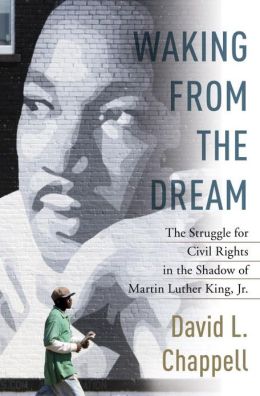
Waking from the Dream by David L. Chappell

waking from the dream

Grade: B+

Note: This book’s release date is January 14th, 2014.

Not to take anything away from the man and his life and his deeds, but the true power of Martin Luther King Jr. seems to be in his name. Just think of what invoking his name can do for a cause. Too often, we forget that the civil rights battle in this country didn’t end with King, but still rages on to this day. And further, his battle didn’t end when he was killed either. His name and legacy have been channeled for five decades now in his absence. In the book Waking from the Dream: The Struggle for Civil Rights in the Shadow of Martin Luther King, Jr. author David L. Chappell examines and details this unfortunately oft overlooked concept. Throughout the book, Chappell takes us through the Civil Rights Act of 1968, the black political conventions of the 70’s, battles for employment bills, the idea of a holiday in King’s honor, Jesse Jackson’s rise, and even the controversial, and almost never discussed, failings of King’s character. Waking from the Dream makes for an interesting read as it shines a light on recent history in just unique enough of a way to drive the narrative and come off fresh.

The controversy over King’s character relates to his marital infidelity, something most people are vaguely aware of. It’s interesting that, as a society, we’ve simply agreed it’s not something we want to talk about. Americans cannot tolerate their heroes being tainted in any way. What is less known, even on that same casual level, is that King, in all likelihood, plagiarized his doctorate dissertation. Chappell tackles this the only way he can, with a detached honesty. He remains a historian throughout, and doesn’t let, for the most part, his own personal feelings get in the way of the facts. It is not an easy thing to discuss the failings of such an iconic man, but Chappell handles it admirably and factually. In fact, an argument is presented, though not dwelled on because that’s not the author’s agenda, that King disliked the idea of lionizing public figures to such an extent that maybe this discredit to his character is not such a terrible thing. It can keep us honest about the deeds of the person rather than the aura of a hero.

Time is spent on the Reverend Jesse Jackson throughout this book, and Jackson does not come off looking great in this book, though it’s hardly an attack on him either. The man is polarizing, he’s charismatic in ways that rivaled King himself, but seems to understand the power of charisma too. Jackson used his influence and power to become an icon in the Democratic Party rather than a pure force for equality. Other figures central in the fight for civil rights are presented too, though none get nearly as much ink as the Reverend.

One of the, possibly unintended, truly fascinating aspects of this book is how little politics have really changed over the past few decades. Chappell, taking us into congressional debates on the Housing Act and King’s national holiday, shows us that the same rhetoric and ideology, with some variation admittedly, has saturated our government throughout modern history. The people change, sort of, and the arguments focus on different angles, but they never really change. Though, easily, the most refreshing thing about this book is that Chappell details his research extensively. A third of the book is citations. In other words, this isn’t bullshit mainstream history in the vein of Bill O’reilly’s Killing Famous People series, but series academic history.
Marvel Comics: The Untold Story by Sean Howe

marvel comics the untold story

Grade: A

Lies, deceit, grandstanding, backroom deals, backstabbing, and the creation of some of the most iconic characters and story-lines in modern history. This is the history of Marvel Comics. Author Sean Howe takes us through over a century, starting with Martin Goodman and comic books starting to take shape in popular culture, all the way to present day with Marvel owned by the monster corporation Disney and pumping out movies and merchandise in addition to the comics themselves. Everybody knows the name Stan Lee, and he is the one figure that hovers throughout the entirety of the book, and even casual comic fans will recognize the names of Jack Kirby, Chris Claremont, Frank Miller and Grant Morrison, but Howe details the contributions, failings and personalities of dozens of other writers and artists that have come and gone over the years. What’s amazing about it is that Howe manages to actually bring all these people to life and get a sense of who they are/were. The strength of this book is that it’s interest is in the people behind the scenes rather than exhausting us with the history of the characters, which any good comic fan already knows anyway.

Regarding Stan Lee: It’s debatable how much, if anything, he actually had to do with any of the creative process throughout the years. He is officially credited with creating such characters as Spiderman, the Fantastic Four and the X-Men just to name a few, and many people take that at face value. This book details how Jack Kirby probably did most of that creating, if not all of it, and essentially got screwed both in a financial sense and a pop-culture sense. That comic book nerds know the legend of Jack Kirby is little comfort to a man who died bitter and resentful, and mostly broke. What makes this book unique is that it doesn’t try to take sides on these issues of creator vs. company. It acknowledges Stan Lee as an amazing salesman who took credit for all these things, but it hardly paints him as a villain. He’s his own tragic figure in fact, taken advantage of by the company while getting screwed in business deals with internet start-ups, while constantly dreaming of Marvel characters being turned into Hollywood movies. That he got his wish as an old man after trying to make it happen since the 1970’s is a testament to his ability to play the long game. Still, he’s something of a tragic figure in that he became a legend for something he really had little love for. He still pines for what might’ve been. He’s quoted saying “I wish I had the time to be a novelist. I think I could have done better. I mean, I would have loved to have written a great novel. I would have loved to have written a great bunch of screenplays. I would have loved to have written a Broadway show. I didn’t have any big compulsion to write comics. It was a way of making a living.” The great champion of comics over the years was just trying to make a buck. In fact, he originally took on the pen name Stan Lee only because he imagined himself becoming a serious writer one day.

This is not Stan Lee’s story though. It’s a story, as the name suggests, of Marvel. The artists, the business men, the presidents, the salesman and everyone in between, Sean Howe brings it all to life. He does it with a fan’s eye but without getting overly sentimental about anything. He freely acknowledges the lack of quality certain eras contained and details the reasons why it went downhill. Each generation brought with it new ideas and new shortcomings. This is not a book about how after a rough road everything is now fine in Marvel land. The company still has its problems, especially in comic sales, and the royalties paid to the artists has still never been solved in any kind of satisfactory way. But it’s the characters that will live on. The artists and the writers come, they leave, and come back. They quit in grand gestures, as stances against the exploitation of the creative staff, sometimes solitary and sometimes in groups, but then they come back because they make comics and there are just not that many paying gigs for comic book writers and artists. Their professional lives parallel the comics they write. The superheroes that die and come back and are stuck in stasis are really the creators who keep telling their stories. There seems to be no permanence in their world, but really it’s only the illusion of change.


Buy this book!