Behind the Candelabra

behind-the-candelabra

Directed by Steven Soderbergh

Starring: Michael Douglas, Matt Damon

Grade: B-

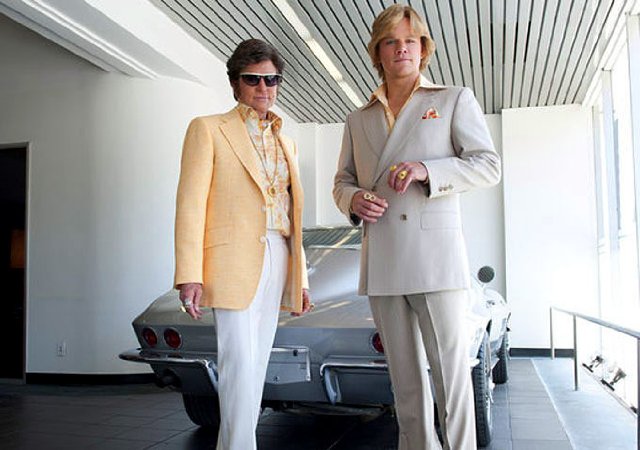
Liberace was a flamboyantly gay man that did everything in his power to hide it from the American public. In that respect, it’s a lucky thing for him that he lived during the times he did, because flamboyancy was expected, and encouraged, by musicians in the 70’s and 80’s, and homosexuality was something you just didn’t talk about in polite society. In Behind the Candelabra, Michael Douglas plays the famous piano player simultaneously as vulnerable and sociopathic. These two traits might seem incompatible, but consider the fact that the sociopath knows that if he’s found out, the fun’s over, and it makes more sense. Liberace is in love with himself, his sexuality and his lifestyle and if the word gets out about the first two, the third’s gone. This movie, not a biopic, is about the last parts of Liberace’s life and his relationship with a much younger man, Scott Thurson (Matt Damon). The film doesn’t attempt at being faithful to the reality of Liberace, because it’s only seen through the eyes of Thurson.

Scott Thurson is a teenager (a quick aside: Matt Damon is aging phenomenally well and looks like a much younger man than his 42 years, but under no circumstances would anyone believe he’s 17 years old and as good as he is in this role, the mere fact that he’s nowhere near the right age for the part reeks of a desire to get some more star power in the film) who was raised by foster parents and likes working with animals. When he meets Liberace, he’s taken away from all these things and set up with everything he could ever want, at least from a materialistic view. He mistakenly believes that Liberace wants a romantic partner, someone to share a life with, when all he really wants is a trophy boyfriend. The relationship is built on image and sex and nothing more, and the deeply disturbed psychosis of Liberace reveals itself when he quite literally tries to remake Scott in his own image. Thurson battles addiction, shame, and loneliness but never loses his genuine naivety and therefore never stops believing that Liberace’s love is honest. The musician’s true intentions are clear to us, the audience, much faster than they are to Scott.

Douglas and Damon are both good in their roles but a few of the minor characters come off more as caricature or simply going through the motions. Aykroyd, as Liberace’s manager, never looks like he’s having any fun at all, while Rob Lowe is so over the top it’s hard to take him seriously. Still, this movie rests solely on the shoulders of the two leads and they come through. Douglas’ Liberace has been putting on a show his entire life and now his life has become the show. A slightly surreal ending sequence suggests that even in death his show is going on. Damon’s Thurson is so naïve and sincere that even when he’s betrayed by his lover and everything is taken away from, his affection never dissipates. A phone call is all it takes to get him back to Liberace’s side.

The problem here is that the idea of Liberace’s entire existence being a show is really all there is to this movie. It’s an idea we accept rather quickly, and then that’s all there is. Since we only see him through the perceptions of Scott, we never really get to know him except through a couple personality traits and disturbing actions. That wouldn’t be terrible, except that we don’t really get to know Scott either. We know he’s young, he’s not terribly bright, he’s very good looking and he’s being manipulated by an older man. The story follows a pretty predictable arch and holds no real surprises and because of that it just doesn’t add up to anything more. This is not a bad movie by any means, but not anything with any staying power either.

Superman: The Unauthorized Biography by Glen Weldon

Superman The Unauthorized Biography

Grade: B

In some circles it’s not a secret, insight or revelation to suggest that superheroes are our modern day mythology. That idea has been explored, and widely accepted, in the greater geek and nerd cultures. To some, though, it will probably seem silly. These are just stories of men and women running around in capes and tights punching other ridiculously dressed beings. The book Superman: The Unauthorized Biography by Glen Weldon is probably for the latter group. For the initiated it’s more a detailed examination of what we already knew, though still a fun read I should point out. The book, obviously, focuses on Superman, and what superhero has more sacred, and godlike, a feel than him? Superman is essentially Zeus and Jesus and probably a lot of other really important God figures in mythology, that is to say, he’s the God of the superheroes. Weldon traces the evolution of Kal-El throughout his 80-plus years, from his socialist, working-class days of protecting the poor from the corrupt rich of his early days, to his stern, but loving Republican father figure that he’s usually perceived as today. Superman is exactly what we need him to be, whenever we need him to be it. The book is essentially a decade by decade examination of the character, and doesn’t just stick to the comic pages. Every incarnation of pop-culture Superman is represented, including the obvious like newspaper comic strips, television, radio and feature film, but also goes into some detail about how the Last Son of Krypton has been merchandised within an inch of his life over the years.

Accepting that Superman has not been the same boring boy scout figure his entire existence, Weldon boils down the two things that are constant, two traits that make Superman, well, Superman:
“1. He puts the needs of others over those of himself.
2. He never gives up.”

These are pretty simple ideas, easy tenets to base a superhero on, but they are utterly unshakeable, with a few notable exceptions over the years that Weldon is eager to point out. With that in mind, as his powers change from an incredibly strong guy who can jump really far to an indestructible demigod to a weird electromagnetic being and back again, Superman changes with each generation. Sometimes he’s moody, sometimes he’s boring, sometimes he’s square and sometimes he’s just kind of a dick. During the depression he stuck up for the working class Joe, while during the Second World War he turned into an uber-patriot, in fact that’s when the phrase “Truth justice and the American way” came about. That catchphrase was deliberately created by the radio show in order to sell patriotism to a fearful audience. The fact is Superman is the most time tested superhero because he has the ability to be what we can’t be, will, in all likelihood, never be. He is who we aspire to be, “…he is not the hero with whom we identify; he is the hero in whom we believe.” This idea comes in the first few pages and Weldon sticks with this thesis throughout the book, as America changes so too does the Ma of Steel. Sometimes crass, sometimes preachy, sometimes hopelessly out of touch, Superman is the ideal we all strive for, as do his fictional peers.

In Superman, Weldon details what’s going on behind the scenes at DC comics throughout the years in order to add life to the book. This makes it an excellent companion piece of sorts to Marvel Comics: The Untold Story, as many of the same writers and artists are given a look. Where Weldon stumbles at times is when he can’t seem to decide whether he wants to be snarky about the Big Blue Boy Scout or not. His knowledge is detailed but he seems to get more enjoyment from making fun of the character than he does celebrating him. It’s okay to be unsentimental about a topic like this and just give a rather straightforward history, but Weldon often seems to only enjoy Superman as a concept rather than a literary figure, except of course when Grant Morrison is writing him.

Superman is often considered a boring character, one who is just too powerful, too good, too white-washed. This book won’t change that perception, but it will give insight to those who know him only through mainstream pop-culture. For those of us who already know why Superman matters, it mostly serves as a fun journey through his existence and an excellent source of trivia fodder. This book doesn’t bring a whole lot new to the table, nor will it likely bring any new fans, but it stands as a solid addition to the Superman cannon and another worthy footnote in The Man of Tomorrow’s life. It’s not a permanent biography, as the character will exist far longer than any of us, enduring is sort of his thing, but a firm reminder of why a fictional alien, an immigrant, captures the ideals of a free world so much better than anything in reality ever could.


Buy this book!

The Master

The Master poster

Directed by Paul Thomas Anderson
Starring: Philip Seymour Hoffman, Joaquin Phoenix, Amy Adams
Grade: B+

Sometimes the controversial or provocative subject matter in a film can dominate the conversation and overshadow the film itself. The Master, directed by Paul Thomas Anderson, is one such movie. Yes, it is a thinly veiled attack on Scientology, there is no question about that and there shouldn’t be. The thing that seems to get missed is that Anderson and his cast aren’t interested in convincing you that Scientology is a fraud, they just accept that it is and move on with the story. To say The Master is a film about the evils of Scientology is like saying Schindlers List is a movie about the evils of Nazism, or The Dark Knight is about the evils of the mob and clowns. This movie is both much simpler than that and much more complex, a simple attack on Scientology is far too easy for a director of the caliber of Anderson. What the film is really concerned with are two men who are drawn to each other despite their best interests, despite the disruption and chaos they cause in each other’s lives. They bring out the worst in each other, though occasionally the best.

The plot follows Freddie (Joaquin Phoenix), a sailor, returning home from war and struggling with a vicious case of PTSD and alcoholism, though it seems clear he had some mental issues beforehand. He drifts around until his special moonshine nearly kills an old man and he’s accused of poisoning him, so he stows away on a boat of what appears to be a well-to-do gathering. There he meets the charismatic Lancaster Dodd (Philip Seymour Hoffman), the leader of The Cause, a cult like collection of people who believe in past and future lives and seek to perfect the soul as it is the true being and the body being merely a vessel. Dodd immediately takes a liking to Freddie’s moonshine and takes him in. The story then goes broad, following Dodd as he evangelizes The Cause, tries to cure Freddie, while his wife, Peggy (Amy Adams), keeps a tight rein on him and his own demons. Also, periodically Freddie flips out and beats the living shit out of anyone who publicly questions Dodd and his beliefs. These are two men headed toward self-destruction, one who is perfectly okay with that, while one is desperately trying to prove there is no crazy. If Dodd can cure Freddie, there just might be hope for himself.

joaquin-pheonix-600

Hoffman and Adams steal the show here. Hoffman brings charisma, danger, instability, manipulation, and boat loads of charm to the role of Lancaster Dodd and makes it so much his own character that the viewer doesn’t need to think of the comparisons to L. Ron Hubbard, because Dodd is his own man with his own set of problems. Amy Adams, meanwhile, keeps herself controlled to the point of unease and to where we understand that while Lancaster is manipulating everyone around him and bending them to his will, Peggy is pulling the strings on him. Peggy never loses her cool, never raises her voice, but is very calmly, and confidently, critical of anything that doesn’t support the survival of The Cause.

The problem here is Phoenix. Joaquin has become like a darker, more twisted, Johnny Depp. He can play weird, strange, intense, and quirky characters very well but seems to leave it at that. Like his Burton-lovin’ peer, he fails to find the humanity in these strange characters he creates. In The Master, there are a few scenes where Freddie feels genuine, and I’m referring to almost any scene where he’s one on one with Hoffman, but for the most part he comes up short. We need to follow Freddie through this movie but he’s just not very empathetic and any time he’s on screen without Hoffman or Adams the film kind of drags.

Destructive friendships don’t always have to end in destruction, and the end of Freddie’s journey, at least the one we see on screen, feels very satisfactory. Of course, the film doesn’t let him off completely easy and it’s slightly ambiguous, but it at least sets up the possibility that he might just have a life ahead of him after all. Dodd, meanwhile, seems to be the true prisoner at the end, chained to The Cause he himself created, his actions seemingly completely out of his control. Their friendship is unsustainable because one wants to conquer the world while the other is simply okay with trying to live in it for a while. Neither man is free, one a prisoner of mental illness and alcoholism, the other a prisoner of ambition, though whose ambition is not entirely evident.

Buy this movie!

http://www.cduniverse.com/productinfo.asp?pid=8870397&style=movie&frm=lk_Somedamnfool

The Summer of Beer and Whiskey by Edward Achorn

the_summer_of_beer_and_whiskey

Grade: A

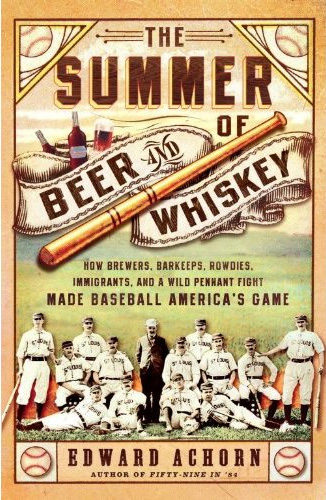
A lot is said today about the tradition and sanctity of baseball. What people tend to forget is that traditionally, the game was played by drunks, brawlers and cheaters. The cheating, in fact, got so bad toward the end of the 1870’s that the American public all but abandoned the game as the major leagues became controlled by bookies and fixed games. Combine that with the lone honest National League pricing the middle class out of games, and baseball, our national pastime, nearly died. Enter a group of ragtag clubs, ran by renegade owners, led by Chris Von Der Ahe, a German immigrant who knew almost nothing about baseball and used his team mostly as an avenue to sell beer, and somehow these guys saved the game. The Summer of Beer and Whiskey by Edward Achorn tells the story of the season of 1883, and how this new league, The American Association, through an unforgettable pennant race, a cast of drunks and outcasts, affordable ticket prices, and all the booze you could want, brought the people back to the stadiums and reignited the passion for baseball.

The action of the story mainly follows Von Der Ahe and Lew Simmons, owners of the St. Louis Browns and Philadelphia Athletics, respectively. Some time is spent with the Cincinnati Reds as well, but the focus remains on the other two. Achorn details the construction of the league and the teams, with a wonderfully nerdy amount of time spent on the personal histories of various players, and then the battles throughout the season and the transactions made to beef up the squads for a pennant run. The Summer of Beer and Whiskey is meticulously researched and written in a mostly unromantic style, and is just as much a history of American city life in the late 19th century as it is a love letter to the national pastime.

This is not one of those history books that “read like a novel.” There is certainly a constant thread and through line, but Achorn isn’t interested in simply entertaining. The book will occasionally go off on tangents that have little to do with the actual season of 1883, like the chapter about the legendary Cap Anson who was not really the great man that we baseball fans grew up thinking he was. He was a vicious racist and was so offended that he had to share a field with a black man, Fleetwood Walker, that he launched a campaign to keep black players out and was almost single-handedly responsible for establishing the color barrier that Jackie Robinson would become famous for breaking more than sixty years later. It’s these asides that breathe life into the book and lend it an air of credibility. It reads like a real history book, relying on direct quotes from players, journalists and owners, as well as directly from press releases and newspaper articles. Achorn is there to provide the prose that turns it into a narrative, but he comes off as much of an observer as we, the readers, do. These aspects can make the read seem a bit dry at times but I personally love that there is no fluffing up of the story in order to create more drama and more romance, just a fascinating look at a game still in its early development.

This book strikes me as incredibly relevant when compared to the criticisms of baseball in today’s world. Steroids, free agency and the mega-contracts it causes, and a perceived coddling of the most expensive players by the clubs seems like a small complaint when compared to fixed games, open racism, and violence against umpires. Still, the core of the game remains unchanged. Sure, there are rule changes and new and improved strategies and methods of talent evaluation, but baseball as a whole remains the same and the passion it creates is every bit as powerful. This book reminds us that it’s not just the tradition that makes us love baseball, but it’s the characters that have populated the fields and grandstands for the last 150 years.


Buy this book!

World War Z by Max Brooks

World_War_Z_book_cover

Grade: A

Editor’s note: I realize I’m way late on this one as this book came out years ago, but with the movie coming out soon, I thought it would be fun to compare the two.

One of the most primal fears that the concept of zombies preys upon is the idea that our world, as it exists today and without being destroyed by something like a bomb or meteor, can become a hostile, dangerous and even uninhabitable place. The cities themselves become our enemies, our own homes death traps. The limit of the genre, historically speaking, is in the desire to give us a consistent protagonist or protagonists, and therefore reducing the danger to an immediate survival story. The world wide apocalypse, while recognized, is more of an abstract thing that doesn’t necessarily feel real. Max Brooks throws all that away in his novel World War Z. By not having a main character to latch onto, except a nameless man conducting interviews and providing the through line, it allows the action to take on a fully global scale.

Since it is written as an oral history, there isn’t necessarily a plot, but there is a clear narrative that runs throughout. The individual stories, with a few exceptions, are completely engaging and capable of standing on their own, but all remarkably add up to something bigger and complete. The basic story, told from just about every point of view you could want, is that the zombies rise, slowly at first with isolated outbreaks. The government scrambles to contain them and keep them quiet. This obviously fails and pretty soon The Great Panic sets in, which is exactly what it sounds like. The people of the world lose their collective shit and society explodes into a fury of chaos and zombie snacks. Our first attempts at fighting back go embarrassingly bad and soon enough the world as we know it is over, Israel has quarantined itself, nuclear war breaks out between two countries, and not any of the two you’re thinking, and general anarchy begins to reign. In desperation, the leaders of the world turn to a South African man known for having plans for catastrophic plans like these but are hard to stomach due to their sheer coldness in terms of loss of human life. They follow his plan, basically willingly sacrificing a good chunk of the world’s population in order to save the rest and soon begin to see the tide of the war turning.

This is not a scary book, though it is frightening. What I mean by that is World War Z is not going to give the reader nightmares of face-eating, gross-looking zombies, but it does serve as a reminder of how fragile everything we rely on really is. The walking dead are merely a pop-culture vehicle used to demonstrate just how easily our governments, societies, cultures, and morals can be torn down. At the end of the day, human beings will do what is necessary in order to continue the species. That sounds pretty bleak and whereas this is no breezy beach read of a novel, Brooks isn’t only interested in bleak. He makes sure to give us a spark of hope at all times and does seem to say that humankind’s resiliency is a good thing, a powerful and unbreakable thing.

In addition to bringing a fresh trope to the zombie fiction genre, Max Brooks proves that he’s truly his father’s son (little known filmmaker named Mel) and brings wit and a sense of satire throughout the novel. He seems to know that zombies are really a pretty ridiculous thing and this kind of book has to laugh at itself before the reader starts laughing at it. Gags go from big picture odd, like millions of zombies swarming the oceans, to low-brow gut laughs like a monkey peeing on a lone survivor of a zombie attack/bridge explosion. It’s these aspects that make this story stand out and transcend an otherwise pretty tired genre. If this book took itself completely seriously it would be a long forgotten, perfectly serviceable, horror novel.


Buy this book!