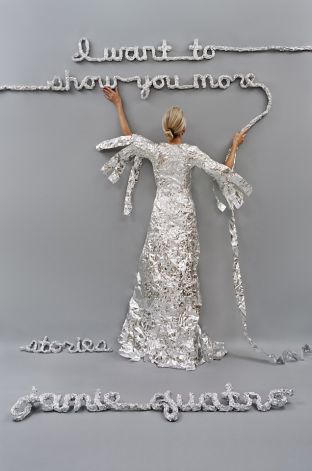
I Want to Show You More by Jamie Quatro

I want to show you more

Grade: A-

A sense of spiritual existentialism hovers throughout Jamie Quatro’s short story collection I Want to Show you More. The characters all feel an enormous amount of loneliness, stemming from things like guilt and fear but always coming back to being alone. An old woman goes to mail a letter protesting the war to President Bush, a girl attends a party with her newly paraplegic mother, and a teenage boy attempts to connect with a sick girl at a Christian camp. These stories are mostly about people seeking, and usually failing in some capacity, to forge some kind of connection to other human beings. Throughout the collection, we keep returning to a woman who has been unfaithful to her husband via a long distance relationship and her struggle to understand her feelings. These recurring stories, to be honest, I wasn’t as enthralled with as the others, but they are necessary in that they produce a thread of continuity and connectivity that ties the independent story lines into one cohesive theme.

In college creative writing courses I remember an exercise. It was simple, have a character walking somewhere, and make a story unfold around them as they go. It could be anything, walking down a driveway, down a street, the destination wasn’t important as much as keeping that forward momentum going. Quatro gives us the best example of this exercise I’ve read in “1.7 to Tennessee.” Eighty-nine year old Eva Brock has written George Bush a letter, informing him that she disagrees with sending young people to war, and is determined that she will walk the 1.7 miles to the post office and mail it herself. As she goes along we get a sense of the town and the people in it, without having to tell us too much about either. More importantly, during her journey, we learn everything we need to know about Eva. She gets confused and disoriented, losing her sense of time and direction, her memories both consume her and fail her, but all along she keeps plugging forward even though her destination becomes increasingly abstract. The story ends tragically, though in very much a non-melodramatic way, and the form letter from the white house received by the post office reminds me of About Schmidt and Jack Nicholson’s realization that none of it matters and connections aren’t real.

In “Better to Lose an Eye,” Quatro masterfully dances on the line of sentimentality. Lindsey’s mother was shot by her boyfriend and is now paralyzed. With her religious grandmother, Lindsey and her mother attend a birthday pool party. Lindsey is embarrassed of her mother and terrified of all the situations where she has to explain her condition. By the end, so upset over everyone’s tendency to ignore her mother, she accepts it herself in a beautiful moment. There is nothing necessarily groundbreaking about this story, just that it’s perfectly constructed. It serves as a reminder just how good a simple, well told story can be and how much it can resonate with a reader.

Quatro crafts her stories with style and all the mystical aspects of southern Christianity. There is tragedy around every corner but she never leaves the reader, or her characters, hopeless. It’s great to drag these people through the gutters and do terrible things to them, but equally important not to abandon all things good, give us some reason to continue on. In this, the stories of I Want to Show you More are completely successful. She gets in a bit of trouble when she starts going too much into the quirky, fantastic worlds she creates. This collection is exponentially stronger when it tells simple, toned down and great stories. Some books of short stories tend to be a bit top-heavy, but this one is actually the opposite, it starts out a bit slow but by the fourth or fifth story you’re hooked. Once the stories get into their groove every one of them is firing on all cylinders and do all the amazing things short stories are capable of.


Buy this book!

Note: Jamie Quatro will be at Changing Hands bookstore in Tempe, Arizona this Thursday, March 28th. Come meet her and get a book signed. Support literary authors and independent bookstores.

Spring Breakers

-Spring-Breakers-selena-gomez-33260560-1500-1372

Directed by Harmony Korine
Starring James Franco, Selina Gomez, Vanessa Hudgens, Ashley Benson, Rachel Korine

Grade: D-

Who needs Reefer Madness when you have Harmony Korine films? His newest movie, Spring Breakers, plays like an R rated Christian propaganda film. Parents, if your kids smoke pot they will turn into murderous psychopaths who fuck older gross gangster men. (Note to parents: If your kid is a stoner psychopath, they’ll still be a psychopath if you sober them up.) Disguised as an edgy and gritty thriller, Breakers is really just an hour and a half long Ned Flanders nightmare. This is the kind of America that my grandparents are convinced exist because the liberals took Jesus out of schools. The screenplay reads like it’s written by someone who’s never done drugs, or met an actual black person, in their entire lives.
The story follows four girls, one who is actually given some semblance of a personality, as they rob a local restaurant in order to fund their spring break trip to Florida. Once on the beach, they party, have sex, do drugs and generally act like assholes. They get busted for doing drugs at a party and James Franco, a drug-dealing rapper who acts like a stereotypical black thug because he grew up as the only white kid in his neighborhood. The girls come stay with him, except for Selina Gomez because she believes in God so she’s the only one with enough sense to get out of that situation. The four girls are down to two. Then one gets shot in the arm by a rival drug dealer and suddenly everything gets a little too real for her and she gets on a bus and goes home too. That leaves the blond one and the other blond one. Their names aren’t important because they’re given no personality, other than that they seem to like drugs and they’ll probably have sex with you if you have some drugs. Asking these two girls to essentially carry this movie is a bad idea because they’re just so horrifically boring and uninteresting people. Finally, the girls go on a murderous rampage, because well, why wouldn’t they?

There are a few laughs in this movie, though almost all of them seem to be unintentional. Franco does get to show off his comedic improvisational skills at times though, particularly in a fairly inspired scene where he’s showing off the things his drug-dealing money bought him. This movie probably would’ve actually worked about a hundred times better if it was just a screwball comedy and they paired James Franco with Will Ferrell and one of the spring break girls were played by Aubrey Plaza. Because at least then the characters would be fun to watch and we could enjoy ourselves. As it is, Spring Breakers takes itself completely seriously, unless I totally missed the point, and tries to come off as a poignant social commentary on how stupid white girls are. Or something like that.

The greatest thing about this movie is that it even fails at its job of being a Christian propaganda film. With all its repetitive shots of titties and slutty girls, it just comes off as a somewhat artsy Girls Gone Wild video. Then by the end, it just devolves into a exploitation film. It’s basically porn for dudes who like pretty young girls in bikinis firing machine guns. If that’s your thing, though, there are far better movies for that. And the hilarious irony of Breakers is that while it strives to be a commentary on the objectification of young girls by all of society, all of society is only going to see this movie because you kind of sort of get to see Vanessa Hudgens naked. Yay.

Go see this movie!

Fandango - Movie Tickets Online

A Maze of Death by Philip K Dick

a maze of death

Grade: B+

Science fiction at its best plays with our fears and anxieties and flips them into a plot about robots and space and crazy technology so we can process everything safely. The genre lightens its social commentary into something that, ideally, entertains as well as challenges preconceived norms. The dystopia convention, for instance, works so well because we’re all scared of some “perfect” society where our freedoms and identities are taken away in order to maintain the guise of perfection. The fears are prevalent, just look at the current fears of Obamacare, or the gay marriage issue, or go back a few years and look at the reaction to the Patriot Act. The passionate reaction comes from the idea that the powers that be are setting up their own society and pulling us all with them, while leaving our true selves behind. This dread and distrust of authority is consistent in any good science fiction story. Philip K Dick is often considered one of the masters of the genre, both in terms of talent and output. Even if you’ve never read him, you’ve seen movies based on his writing, either loosely or directly. I am a newcomer to him, and Maze of Death is in fact the first novel by Dick that I’ve read. This particular book sort of ushers in his later years, where he became much more spiritual in his writing. The transition is evident, if crude, as he wrestles with all kinds of questions of god and faith, and the role they play the universe.

The story follows Seth Morley, mainly, and a cast of other characters called to work on Delmak-O for reasons that are not made clear to any of them. Morley is happy though because he prayed for a transfer and is content with the notion that his prayers have been answered. In this reality, deities are accessible via prayer transmitters and are a physical presence in the universe. Once on this seemingly uninhabited planet, the new residents don’t find it too welcoming. In the now familiar trope, they are trapped on an unfamiliar area with a malevolent force killing them off one by one, or at least they assume it’s a malevolent force, the one their beliefs call the form-destroyer. The characters rely on their faith and individual intelligences to attempt to band together and stay alive and hopefully escape the planet. If you know anything about science fiction, you know there’s a twist, and you probably know that the twist somehow involves the twisted nature of man rather than some god-being with a grudge against his creations. The twist is fun, but it’s not really the most important part of the book. The theme that is most significant is the idea that, on this world, for whatever reason, God has abandoned these people, and the truly special part of this book is the wrestling match these characters have with their faith and their loyalty and duty to each other. Dick, in his early spiritual journey, seems to have trouble believing that man, left to his own devices, is capable of surviving. In fact, beyond even that, he seems to suggest that without God, man will resort to murder and abandonment of his humanity.

Dick writes in a simple, but articulate style. Though he seems to have a basic understanding of it, he’s not interested in bogging the reader down with the nature of the technology this universe possesses, just that it works. I find it refreshing that there are no long passages over-explaining the various concepts that might seem foreign to us because we don’t live in a society that has mastered space travel. These people can travel across galaxies, we can’t. Good, got it. What this allows him to do, is to focus on the story and make the action accessible without detracting from the believability. The same logic is followed with the characters. None of them are developed too much, though I’m glad he resisted the urge to paint them as caricatures since he’ll be killing most of them off anyway, and are given just enough personality to move the plot forward. This is not a character study, this is a meditation on man’s relationship with God and needs to keep the action constantly moving in order to achieve its goals. Normally, I would be slightly irritated at the lack of character development but here it feels natural, after all if his thesis is that man is defined by his relationship with the divine, then painting fairly hollow characters makes complete sense.

This being my first Philip K Dick novel, I feel I’ve finally earned the right to stand among the ranks of the nerds. My new plan is to read two of his novels every year for the rest of my life. There’s like 46 of them or something, so assuming I don’t live an annoying long time, this should keep me occupied.

Note: This novel was originally published in 1971 and is currently out of print. It is due to be re-released on April 16. If you want to read it, I recommend you go to your local used bookstore, or preorder it from this website.


Preorder this Book!

Life of Pi

life of pi

Starring Suraj Sharma, Irrfan Khan

Directed by Ang Lee (Winner of the Oscar award for Best Director for this film)

Grade: A-

Life of Pi centers around a fairly simple question with complex answers. What matters more, the truth of a story or its merit? Especially if both stories convey the same devastation and heartbreak, but one adds moments of beauty and illumination and the proverbial triumph of the human spirit. This is dangerous territory because it’s so easy to cop out with ambiguity, but this movie never removes or shies away from the complexity and refuses to make things simpler even if it means denying us the traditionally satisfying resolutions we so often crave at the movies.

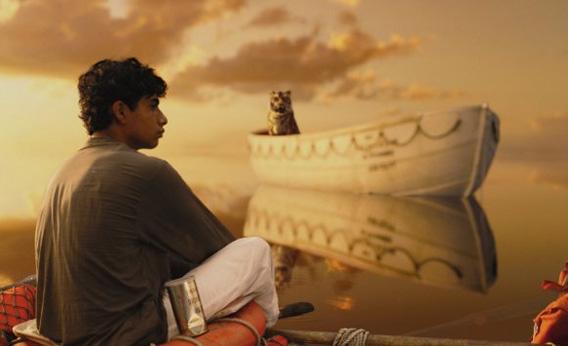
Suraj Sharma stars as Pi, the son of a zookeeper in India who, along with his family, relocates from India to Canada. On the voyage, though, something goes wrong. The ship sinks, and Pi is stranded alone out at sea. Well, he’s not really alone, there’s a full grown Bengal tiger in the lifeboat as well. A tiger in the boat and sharks consistently circling around the craft, neither is a very promising option. The story follows Pi along his journey out at sea and his desire to not just survive, but remain a good man. He seems resourceful enough, he could probably figure out a way to kill the tiger, named Richard Parker because of a clerical error, and in fact is even presented with a golden opportunity at one point but chooses to save the wild animal. Pi, who is a Hindu, Catholic, Muslim (“We get to feel guilty before hundreds of gods”), and raised by a father who values the secular world and rational thinking above the mystic. Giving into selfishness, even if it’s necessary for his survival is not an option. Throughout their time together they learn to tolerate each other. It’s not a Disney-esque friendship that blossoms, but rather a mutual respect, begrudging on Richard Parker’s part.

I didn’t see this Life of Pi in 3D as I’m not a particular fan, but nevertheless this was one of the best looking movies I’ve ever seen. The CGI, while not always completely believable, though I believe intentionally so, is far more satisfying and well executed than any summer blockbuster of the last year anyway. If you get nothing else from this movie, see it for the visuals, it’s very much worth your time.

My only real complaint about this movie is the book endings. While Irrfan Khan does a great job as the adult Pi recounting his story, in fact the haunted but contented look in his eyes is pretty spectacular, I was a bit bothered by the presence of the writer. First off, it feels a bit cliché, as it’s something that’s been used time and again. Second of all, and maybe I’m reaching a bit, why did the writer have to be white? This is a movie all about Indians, well mostly, and though they’re in Canada during the telling of the story, it feels a bit manipulative. It’s as if by making the writer white, it’s assuming most of the audience is white and that makes this story about people from India hanging out with wild animals while stranded at sea so much more exotic. I don’t really think it needs to be any more exotic, let the story speak for itself. Overall, a small complaint, I just don’t like when I feel like I’m being pandered to.

The ambiguous ending, often used as a cheap tactic to trick people into thinking the film’s smarter than it is, is actually perfect. If you think of Pi as a man of many faiths, all of which he holds to be true, then you can see that both of his stories contain the truth, because all stories (i.e. religions) contain truth, if not a universal one, then simple some truth
we need.

Buy this movie!
http://www.cduniverse.com/productinfo.asp?pid=8855214&style=movie&frm=lk_Somedamnfool

Dolores Greyson in “Taking Action”

The following flash fiction is the latest in the series “MacDougal Drive” featured on this site and The Roost

The previous entries

Bill

Jimmy

Dolores

Harley

Bill Vol. 2

Jimmy, too

The weeds had grown high and their roots clung to the deep parts of the earth. Dolores dug a perimeter around, gripped tightly and pulled the stubborn roots out. She was careful to not leave anything behind as the weed would soon be back to full height if she missed any part. The sun was high and bright but not painfully hot. This was the kind of day that normally would have brought her peace, but nothing was normal anymore. Not since Walter, not since the attacks on those kids. Everything was wrong.

Bill came out of his house, a half-smoked cigarette dangled from his mouth, and headed down the driveway. He nodded in her general direction but offered no greeting. His eyes were bloodshot and yellow sweat stains spotted his undershirt. She could practically smell the stale booze even from this distance. She watched him disgustedly as he rummaged through the mail and flicked his butt into the dry gutter, and then scratched himself without any shame.

“How’s your mother, Bill?” She called out to him on his way back up the driveway.

He slowed only slightly, replied without looking at her. “Stronger every day.”

“You give me that answer every day.”

Bill stopped and finally looked at Dolores. “Mrs. Greyson, she might just outlive us all.”

“The way you’ve been carrying on, that doesn’t surprise me.”

He lit another cigarette. “What’s that mean?”

“Don’t think I don’t hear you coming home late from whatever sin infested hole you’ve been, stumbling drunk and laughing like a maniac.”

A smile crept across his face. “Why, Dolores, have you been spying on me?”

She shook her head in disgust. “You’re a grown man, Bill. Start acting like it.”

The smile disappeared. “I don’t mean any disrespect.”

“You’ve got responsibilities.”

“I’m honoring them.”

They stared at each other for a long, drawn out moment. Bill then turned and went back to the house.

“You shouldn’t smoke in the house, there’s a sick woman in there.”

No reply. Bill closed the door behind him. Dolores felt herself grow hot with rage. This whole world made no sense to her anymore. She went back down on her knees and started pulling at the weeds again.

She could feel the slight extra weight of the glock tucked into the waistline in the back of her pants. That weight brought her comfort. She tried for a moment to remember just when she had started carrying the weapon around with her as she gardened, but couldn’t quite put her finger on it, probably a couple months. A growing distrust of this neighborhood, the same on she had lived in for over forty years, constantly threatened to overwhelm her. This street, this town, this world really, needed cleaning. Disease was spreading all around, tainting everything she held dear. Walter wouldn’t have stood idly by, he’d have taken action. That was just the kind of man he was. Dolores felt her eyes grow wet so she shoved everything from her mind and refocused her concentration to the task at hand. With the right tools and some determination, these weeds posed very little problem. A slight breeze picked up and for the briefest of moments, it washed away the smell of decay that had recently saturated MacDougal Drive.