American Boy by Larry Watson

american boy

Grade: B

Simple, small town American stories are going out of style. Modern audiences, even the “literary” among us, want more, a bigger vision and preferably something quirky somewhere in the story. This isn’t really a bad thing as writers should continue to push the envelope, and after all, what more can really be said about small town life? But sometimes it’s nice to be reminded why a trope worked so well for so long. In the novel American Boy, Larry Watson tells a simple story, set in the early 1960’s in Willow Falls, Minnesota, that succeeds as both an ode to a small town and a coming of age tale, even when it comes up a little short in other areas.

The story follows Matthew Garth, a poor kid with a dead father who has more or less been adopted by his friend Johnny’s family, the Dunbars. The father, a doctor, teaches the boys medicine and is more or less grooming them to be doctors themselves one day. The novel opens with a gunshot victim, Louisa Lindahl, being brought in during Thanksgiving. After a glimpse of her wounded, naked body, Matt becomes infatuated with her. He attempts to court her in ways that only an unsophisticated, seventeen year old boy can think of, and naturally comes up short. His pursuit, and obsession, of her unveils Dunbar family secrets that could threaten the model of perfection. Until a disappointing ending, which I’ll get to in a minute, American Boy is very much about the power the successful have over the poor.

What drives this novel more than anything is the voice. It is told in first person from Matt’s perspective. Matt’s worldview, and therefore our worldview, is limited by his age, his lack of experience, and his lack of access to anything bigger than himself. This voice feels amazingly authentic, and has the power to make us feel every bit as frustrated as the protagonist when he fails or is withheld information. We only get to know the other characters from his view, so they are always seen through a filter and never fully realized as human beings. This isn’t a complaint, but rather an observation that the Dunbar family and Louisa only exist as ideas in Garth’s mind, so naturally we’re only going to get these glimpses of them. Sometimes the writing isn’t quite as sharp though, like when Watson constantly insists on deviating from the action to let Matt reminisce about something that’s clearly a metaphor for what’s currently happening. It would’ve been wiser to just stay focused on the moment and let it speak for itself. Don’t telegraph the meaning for us, we’ll figure it out.

Okay, about that ending. The whole novel lets itself unravel slowly and naturally. The tension builds and builds, and we figure out certain things long before Matt does, until it hits a boiling point at a small motel in Bellamy. The class commentary is in full force at this point, when during a fight, Matt observes “Father and son kept me down long enough for me to be reminded again as to who possessed power and weight in the world.” Up until, and including, this point, the book was engaging and heart-wrenching, but then the last few chapters speed up and rush to an ending that is fairly unsatisfying. We get another chapter in the present, then a fast forward into the near future, where we discover that Matt did just fine on his own. This ending robs of us two things: the first being a satisfying resolution to the actual story line. The second is a bit more abstract. The novel, working as a haves versus have-nots feels authentic and poignant, until it seems to cop out at the end. Having Matt be successful in life, and not just successful but successful because of what Doctor Dunbar taught him, feels like a cheat. The message seems to be that the rich can do whatever they want, but pay attention to what they have to teach and you’ll do just fine.

This is still a worthwhile read, and a reminder that Larry Watson is one of our great contemporary novelists. It may be far from perfect, but it’s refreshing to read a simple story that, for the most part, stays simple and true and moving. Every once in a while, something that’s old-fashioned and out of style can feel fresh and exciting when done well.

Buy this book!

Bossypants by Tina Fey

Bossypants_Cover_(Tina_Fey)_-_200px.jpeg

Grade: B

Comedian memoirs are a tricky thing. Often times, the writer will want to broach serious issues and ruin our good time because we just want them to make us laugh, damn it. To be fair, a good amount of the time this is due to poor or manipulative writing and the rejection is well deserved. Very few of these books transcend the genre and become something else, Steve Martin’s Born Standing Up being, arguably, the best example of this. In Bossypants, Tina Fey does occasionally, but not always, achieve this. She has an agenda (Note to my conservative readers: Please don’t read that as “Liberal Agenda” because that’s not what I mean and that word doesn’t always have to have negative connotations), being the general view of female comics and the unreasonable backlash one gets from simply being female in the comedy world, and sticks with it pretty much throughout the book. Fey, being a champion of women in comedy, almost has a responsibility to visit that theme again and again. She does this through the insight of her own experiences, which are obviously extensive and relevant, and light-hearted, self-deprecating humor running throughout.

This is not a straight forward memoir in the sense that there is no obvious through line. She jumps around in time to periods she feels are most relevant to the themes of the book, and there are frequent asides, such as her tribute to the greatness of Amy Poehler, which will be frustrating to readers who would prefer a more traditional biography, but is refreshing to those of us who are tired of traditional biographies. There are topics she avoids, mostly things that would infringe on the privacy of those she cares about. One particular, though, is that she very much does not want to talk about her scar. It’s perfectly understandable that she wouldn’t, and it’s also perfectly understandable that people are curious about it. She gets around this by addressing it almost immediately, giving an absolute barebones detail of the event and giving nothing more. She doesn’t necessarily avoid it as its referenced a few times throughout the book, but by not harping on it or giving it too much weight, she prevents making Bossypants a somber account of her life. This is very much a comedic book with serious elements to it, and by dealing with the elephant in the room immediately and briefly, we’re free to move on to the good stuff.

The best parts of this book, for me, are the behind the scenes of Saturday Night Live. I’m a sucker for these stories since I’ve been watching that show every week since I learned how to wake up in the middle of the night while my parents were sleeping and turn the TV on very quietly. The show has always famously had a reputation as a boy’s club, and there are some great stories in this book concerning that, and offering a different, less jaded, perspective. Since she is possibly the most successful woman to come out of SNL, Fey has a unique opportunity to tackle this issue and show how it’s not something that is set in stone. It’s not all about this issue though, there is plenty of fun to be had as well. She describes her audition process, table reads, and, of course, her run as Sarah Palin. Through her, we get to know Lorne Michaels and Amy Poehler to some degree, but in her effort to not have this book be seen as a tell-all, she keeps everyone else at arm’s length. Instead Fey keeps the focus perpetually on herself, this being her book and all that is understandable. This doesn’t come off as narcissistic, I don’t want to suggest that, but it does come off as a bit overly cautious at times.

I don’t think Fey is comfortable going very long without a laugh. As a comedy writer this makes a ton of sense, but it can also cheapen this book at times. Occasionally it gets a little too jokey when it’s not really called for. Don’t get me wrong, I’m not saying this book isn’t funny, because it is, but there are moments when it doesn’t feel that the material is being fully trusted, so a self-deprecating anecdote or observation is thrown in at the tail end of a rant, lest we think she’s one of those feminist types. Tina Fey is an extremely funny person, but also a good enough writer to not always have to fall back on humor. All I’m saying is, we already like you, Tina, don’t always try so hard to impress us.


Buy this book!

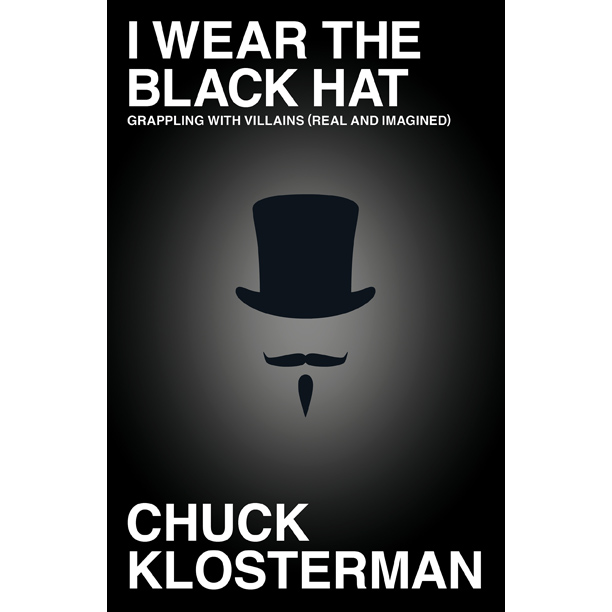
I Wear the Black Hat by Chuck Klosterman

I-Wear-the-Black-Hat-jacket_612x612

Grade: A

Why are the villains in stories so much more fascinating to us than heroes? A possible reason is because we have an easier time identifying with the villain as most of us aren’t particularly heroic ourselves. Don’t think for a second this is limited to fictional universes either. Nothing makes us happier than jumping on a real-life villain, or better yet dragging our heroes down into villainy so we can safely hate them. But it’s simple enough to state these facts, many people would be able to state what I just did and many additional people would agree with these sentiments. So then, back to the question of why. In I Wear the Black Hat, Chuck Klosterman, in a series of essays, attempts to offer some insights, though never answers because he accepts pretty quickly there are no perfect answers.

Anybody who has ever read Klosterman understands of his obsession with pop-culture. What sets him apart from some writers tackling the subject is that he’s highly intelligent and very funny, and gets that pop-culture works as a reflection of us rather than a gag that stands on its own. He goes up and down the pop-culture ladder, everywhere from sports to movies to comic books to politics, ridiculing as necessary but always turning a sympathetic eye towards his subjects. These references and allusions are mainly broad strokes, an effort to suck you in by wit and memorable references, used to reflect on his personal experiences and the nature of villainy in his own life. This makes for a remarkably intimate read when in the hands of lesser writers would feel silly and trite.

The specific topics include, but not limited to: comparing Batman with Bernard Goetz, Why OJ Simpson is really a villain (other than the obvious), why it’s basically required to hate The Eagles, and just why Andrew Dice Clay is still so looked down upon when acts just as vulgar as he ever was have become remembered as genius in retrospect. He also tackles Joe Paterno, Bill Clinton and Monica Lewinsky, Machiavelli, and even, though very reluctantly, Hitler. These essays obviously vary in topic but all aim for a greater purpose, and succeed far more often than not. These essays are concerned with the public’s relationship with villains and at what point we can no longer forgive and forget. Why can some come back (Bill Clinton) but others will never be welcome (Dice).

The answer is not easy, to say the least, because villainy, or evil if you want to take a very narrow look at it, is complicated. Think about some villains in pop-culture. Tony Soprano, Randall McMurphy, Charlie Sheen, all of these guys, to varying degrees, do deplorable things that would outrage us if they invaded our personal lives, yet we root for them every step of the way. We love to read books about serial killers, and they actually do exist in the real world, but so few of us can relate to the personal fear of being hunted by a Ted Bundy that they seem fictional. Are we so fascinated with the darkness that resides in ourselves that we care more about Darth Vader than we do about Luke Skywalker? Chuck Klosterman seems to think so, and thankfully he’s willing to take it on himself, by (ahem) wearing the black hat for all of us.


Buy this book!

William Shakespeare’s Star Wars: Verily, A New Hope by Ian Doescher

2013-05-04-shakes_starwars-533x355

Grade: B

At first the idea of combining Shakespeare and Star Wars sound, at best funny, and at worst downright asinine. But if you think about the fact that George Lucas famously, and openly, gutted every myth, fable, and classic story he could find to tell his epic, then why not team him up with the man who is arguably the most classic storyteller ever? In William Shakespeare’s Star Wars: Verily, A New Hope, author Ian Doescher does just that. Turning the original movie into a play and translating all dialogue, and stage directions, into iambic pentameter, this book is at turns inspiring and odd, brilliant and jarring, but always highly entertaining. I imagine the target audience is fans of the films rather than those enamored with The Bard, but that doesn’t cheapen the work Doescher put in here, mostly because in some respects it’s already kind of cheap. Though I don’t mean that as an insult, really.

You know the story, or at least you should, as a matter of fact if you don’t you should just leave and not come back on the internet until you know the story of Star Wars, so I won’t summarize it here. What you should know is that it plays with what we know of the characters, using information we won’t learn until the subsequent films to deepen the likes of Darth Vader and even R2D2. Some of the best parts of this book are when Doescher writes soliloquies for various characters. In addition to having fun with the Star Wars universe and the language therein, they provide us new insights into beloved pop-culture icons. Take R2’s aside in the opening scenes:

“Around both humans and the droids I must
Be seen to make such errant beeps and squeaks
That they shall think me simple. Truly, though,
Although with sounds oblique I speak to them,
I clearly see how I shall play my part,
And how a vast Rebellion shall succeed
By wit and wisdom of a simple droid.”

It’s not a new idea to suggest that the entire saga revolves around the droids, hell that’s kind of what Lucas intended for the first half of A New Hope, but it certainly is new to put such depth and motivation into R2D2. He always seemed cunning, but never plotting, if that makes sense.

The real draw of this book is to read some of the quotes out loud to your nerdy friends though. Here’s my advice on how to enjoy this book (well, read it all the way through of course because if you’ve read this far into the review you’re probably a Star Wars geek and you owe it to yourself to experience such an odd venture, damn it.): Get yourself a case of beer and some buddies, drink and open to a random page and start reading out loud. Everybody will enjoy themselves, and anybody who doesn’t isn’t really your friend anyway.

The downside of this book? There are two things. The first is simple: It’s kind of a novelty. I don’t doubt that Ian Doescher put a lot of effort into this, and I do hope that it’s successful enough for him to do the other two movies, but it’s ultimately going to be forgotten on the bookshelf in a matter of weeks. The second problem is maybe a bit more abstract. This book is going to inspire so many shitty theater productions of Verily, A New Hope that I already want to cut funding for drama programs throughout the country. Don’t believe me? It’s all too real and it’s already started. There will be some who take this too seriously and we’ll all suffer for it.


Buy this book!

American Dream Machine by Matthew Specktor

american dream machine

Grade: A

A Hollywood story is a tricky thing to write. Especially nowadays, when the public love affair with the movie industry is long over and we view celebrities as over-privileged rich assholes who keep butting into our social and political arenas and ought to just shut up and entertain us. Monkeys. How then does a writer proceed? The easy answer is to view the industry, and the entire town, indeed as many have done, with a cynical eye. Render those Hollywood types into shallow caricatures who we can laugh at even though their lives are better than our own. But in American Dream Machine, author Matthew Specktor doesn’t take the easy route. He uses the town, and the film business, as a backdrop to tell the story of a man’s rise, fall, rise to even greater heights, spectacular fall, rise yet again, and once again fall, and how the echoes of this man’s successes and failures affected his offspring. In short, this book is a deeply personal tragedy, or series of tragedies really, that, while remaining cooly detached enough to stay hip and not delve into melodrama, isn’t afraid of deeply sentimental moments.

The novel follows the life of Beau Rosenwald-seen through the eyes of his illegitimate son Nate-and his extreme ups and downs. Beau is overweight, ugly, and obnoxious, but can talk his way through any situation. He’s a Hollywood agent who loves what he does for only the most visceral of reasons. He’s no artist, no fan of art in fact, but believes powerfully in movies and loves the challenge of the deal. American Dream Machine tells his life story, and through it, brings life to Hollywood, the film industry, and the sense of time passing. Time passing is a big theme in this novel as it has no problem skipping ahead great amounts of time yet never losing its sense of urgency. The title itself refers to the name of the talent agency that Beau opens with his friend Williams, along with a few other colleagues, and conquers Hollywood with. There is everything you expect in a novel like this, power struggles, personal and professional tragedies, the straining of the offspring of powerful men to separate themselves from their fathers, but though all this seems familiar, the novel never delves into the cliché. The material is fresh, mostly due to dead-on characterization, pitch-perfect dialogue, and a cynical love of all the characters that inhabit this world.

There is a mystery, a few mysteries in fact, moving the plot forward in this book. The mysteries involve an unexplained death, a missing person, and family trees. The beauty of these mysteries is that the novel doesn’t depend on them. They’re plot devices, yes, but it’s more that they’re character defining obsessions. The reader won’t even fully realize we’re reading a mystery until we come to the big reveal moments, and then realize we’ve been hooked all along. This will not be marketed as a mystery novel, and rightfully so as it has just about nothing in common with the Grishams and Pattersons of the world, but it seems to have the potential of a crossover hit.

Specktor’s voice is the standout star of this novel. He’s funny, he’s tragic, and most of all, he’s a story-teller. The fact that this novel spans over 40 years means naturally we’ll get to know a lot of different characters. People come and go throughout, and yet all of them feel fully realized and complicated. Time is such an important issue in this book and is dealt with masterfully. Specktor has no problem, often in the context of a single paragraph, reaching far back or forward in time. Using time this way, there is a constant uneasy sense of tragedy looming on the outskirts at all time. We know things are going to go bad, because we’re told all along that they will, so when the tragedy hits it feels like a foregone conclusion, a destiny.

This is Specktor’s third novel, by my count, and though I have yet to read his other work, he seems to be a rising star. And if word is true that this novel has been optioned for a Showtime series, then that could mean we’ll be hearing a lot more from him. To which I say, hooray.


Buy this book!