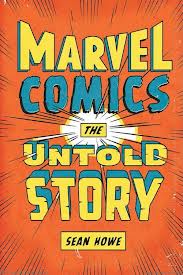
Marvel Comics: The Untold Story by Sean Howe

marvel comics the untold story

Grade: A

Lies, deceit, grandstanding, backroom deals, backstabbing, and the creation of some of the most iconic characters and story-lines in modern history. This is the history of Marvel Comics. Author Sean Howe takes us through over a century, starting with Martin Goodman and comic books starting to take shape in popular culture, all the way to present day with Marvel owned by the monster corporation Disney and pumping out movies and merchandise in addition to the comics themselves. Everybody knows the name Stan Lee, and he is the one figure that hovers throughout the entirety of the book, and even casual comic fans will recognize the names of Jack Kirby, Chris Claremont, Frank Miller and Grant Morrison, but Howe details the contributions, failings and personalities of dozens of other writers and artists that have come and gone over the years. What’s amazing about it is that Howe manages to actually bring all these people to life and get a sense of who they are/were. The strength of this book is that it’s interest is in the people behind the scenes rather than exhausting us with the history of the characters, which any good comic fan already knows anyway.

Regarding Stan Lee: It’s debatable how much, if anything, he actually had to do with any of the creative process throughout the years. He is officially credited with creating such characters as Spiderman, the Fantastic Four and the X-Men just to name a few, and many people take that at face value. This book details how Jack Kirby probably did most of that creating, if not all of it, and essentially got screwed both in a financial sense and a pop-culture sense. That comic book nerds know the legend of Jack Kirby is little comfort to a man who died bitter and resentful, and mostly broke. What makes this book unique is that it doesn’t try to take sides on these issues of creator vs. company. It acknowledges Stan Lee as an amazing salesman who took credit for all these things, but it hardly paints him as a villain. He’s his own tragic figure in fact, taken advantage of by the company while getting screwed in business deals with internet start-ups, while constantly dreaming of Marvel characters being turned into Hollywood movies. That he got his wish as an old man after trying to make it happen since the 1970’s is a testament to his ability to play the long game. Still, he’s something of a tragic figure in that he became a legend for something he really had little love for. He still pines for what might’ve been. He’s quoted saying “I wish I had the time to be a novelist. I think I could have done better. I mean, I would have loved to have written a great novel. I would have loved to have written a great bunch of screenplays. I would have loved to have written a Broadway show. I didn’t have any big compulsion to write comics. It was a way of making a living.” The great champion of comics over the years was just trying to make a buck. In fact, he originally took on the pen name Stan Lee only because he imagined himself becoming a serious writer one day.

This is not Stan Lee’s story though. It’s a story, as the name suggests, of Marvel. The artists, the business men, the presidents, the salesman and everyone in between, Sean Howe brings it all to life. He does it with a fan’s eye but without getting overly sentimental about anything. He freely acknowledges the lack of quality certain eras contained and details the reasons why it went downhill. Each generation brought with it new ideas and new shortcomings. This is not a book about how after a rough road everything is now fine in Marvel land. The company still has its problems, especially in comic sales, and the royalties paid to the artists has still never been solved in any kind of satisfactory way. But it’s the characters that will live on. The artists and the writers come, they leave, and come back. They quit in grand gestures, as stances against the exploitation of the creative staff, sometimes solitary and sometimes in groups, but then they come back because they make comics and there are just not that many paying gigs for comic book writers and artists. Their professional lives parallel the comics they write. The superheroes that die and come back and are stuck in stasis are really the creators who keep telling their stories. There seems to be no permanence in their world, but really it’s only the illusion of change.


Buy this book!

The Grey

images

The Grey
Starring Liam Neeson
Directed by Joe Carnahan

Grade: B-

To be honest, I wasn’t very excited about seeing this movie. In fact, the first time I saw the trailer I laughed my ass off. What a ridiculous concept. Liam Neeson is a fine actor who has stumbled his way into self-parody over the last few years. We all liked the first Taken so now he just feels he has to make movies where he punches things. So combine Neeson’s recent track record, a director that doesn’t inspire a lot of confidence and a terrible trailer, and I assumed I had it pegged. After seeing it, though, I’m going to go ahead and chalk it up to another victim of mis-marketing. It’s a quiet, contemplative movie that deals more with existential crises than wolf vs man action. I’d say it’s sort of like Open Water, if being stranded in the ocean was a metaphor for the absence of God.

Neeson plays Ottway, an Alaskan oil rigger and a widower who’s on the brink of suicide. We know this because he reads us the suicide note he’s writing through the magic of voice over. A note to film-makers, 93 percent of the time you’re thinking about using voice over, don’t. He’s sad and writing something, then he goes to the bar for a contemplative drink, then puts a gun in his mouth. I’m intelligent enough to figure out that it was a suicide note that he was writing. Make me work a bit as you do with the rest of the movie. Then Ottway and some fellow riggers board a plane to Anchorage for some R&R time which means hookers and booze. All in all, it takes about 15 or 20 minutes to get to the meat of the action. The plane crashes in the middle of nowhere and it’s quickly established that no one will come looking for them, and even in the unlikely event they do, they certainly won’t find them. These men are on their own.

A nice clue that this isn’t simply another action movie is that the only woman in the cast is a flight attendant and she’s killed in the initial crash, and I don’t recall a single line of dialogue from her. A lesser movie would make her survive and thrust Ottway into the role of her protector, who then slowly sees his icy heart melting from her sheer feminine goodness. This doesn’t happen here, because she’s dead and we’re not interested in redemption.

The surviving men are trapped, and dying off pretty rapidly. Most are killed off by wolves, others by harsh conditions. There are some attempts to fight back against the wolves, but these are not bad-ass brawls or Schwarzenegger-esque action sequences. Instead, they’re desperate, fumbling attempts at killing their attacker. It’s pathetic and sad and human. Ottway is their leader and, just like every other recent Neeson character in recent history, he is the smartest and strongest among them. This is pretty fair though, as I imagine if I ever meet Neeson there would instantly be no doubt who was stronger and smarter. He’s a very intimidating man. The nice variation on that idea in this film is that, though he is smart and seems to act when nobody else will, all of his ideas don’t work and lead to disastrous results. Every decision that is made just leads them further away from hope. The wolves know how to survive in the frozen tundra, the men don’t, and the movie never pretends it’s the other way around.

All this builds to the climax. Now we’re getting to the wolf fights, right? Well no, not really. What we get is Ottway sitting alone, freezing and wet and terrified looking up at the sky and demanding that God give him something, anything. He deserves some kind of sign, some signal that this all has some meaning. When he gets nothing from God he says “Fuck it, I’ll do it myself.” This sets him on his final path and a delightfully ambiguous ending. Some people will want to know more, will want to know what happened. But whether he lives or dies is not important, hell he already accepted and embraced death in the opening shots of the movie, dying is not really much of a climax in that scenario. No, what matters is what “Fuck it, I’ll do it myself” means. Does it mean that he’s made his peace with God or that he’s shunning him? Does it mean that he’s accepted that there is no God and humanity is ultimately on our own or that God is real and simply demands that we forge our own path? Both of these answers are acceptable dramatically, but the fact that it’s unknown allows us to place our own prejudices on the subject matter. Religiously inclined people will see it one way while unbelievers will see it another.

Dolores

re: Jimmy

(Editor’s note: This post is part of the new experiment by this site and The Roost. It is an ongoing flash fiction serial with the working title “MacDougal Drive.” There will be weekly stories. This is the third in the series.)

The news reports kept coming in. Monotone voices of the anchors and the background screeches of sirens and screaming and mayhem combined with the hum of the broken ice machine created a white noise that hovered throughout the house. Dolores Greyson hated watching the news, couldn’t figure out why she did it to herself, proving Walter right. The world really was going to hell, Walter had taught her that, and the news proved that every day.

But those poor kids. Who would attack two boys like that? The evil was spreading, she could feel it in her bones. And the news anchor had the nerve to suggest it was a blessing that one of them had survived the assault. She could hear Walter’s voice, talking about getting a posse together to go after the bastard. He’d left her his entire arsenal, taught her how to shoot. His last gift to her. She saw his face then too, crusty and dying. He told her not to let the scum infect her like it did him. The government had given him cancer through years of testing rockets and God knows what else up on that hill where he had worked. Walter knew in detail the destruction that they were capable of. “Stay vigilant, stay strong.” He had told her.

The knocking at the door cast Walter’s decrepit face away. Dolores eyed the door suspiciously, massaging the .22 in her lap. The knock came again and she reluctantly placed the gun under the cushion and answered the door.

The man standing on her porch was balding and overweight, wore a Maytag work shirt. He was unassuming in all the right ways. The tool box he gripped, too tightly, contained God knows what.
“Understand you’re having problems with the ice maker, Ma’am.” He smiled, but it never touched his eyes.
“I was starting to think you weren’t coming.”
“Sorry, this is my last stop.”
“Well come on in.”
He came in and headed straight for the kitchen, opened up the freezer. He hadn’t given her a name. Bad manners or something else? Something worse? She was old but a good shot. Could she make it to a gun fast enough? He was sure to be quicker than her.
“Terrible about those kids,” he said.
“This world’s sick.”
“Can’t argue with that.” He pulled a screwdriver from his toolbox. “Of course, you gotta wonder if it’s our fault somehow.”
She tensed, inched towards the couch. “Our fault?”
“Maybe we manifest these freaks because of our addiction to shock media.” He looked at her with an unsure smile. “Sorry, I took some sociology classes in college and I sometimes try to impress people with that fancy talk.”
Dolores arrived to the couch and slid her hands between the cushion. She could feel the handle. “Well count me as unimpressed. Whoever attacked those kids is sick, and that’s that.”
“Sorry, ma’am. Didn’t mean anything by it.” He stood up and closed the freezer. “There, that should do it.”

The humming had stopped. Some order felt returned, but now she readied herself for the attack. He walked back through the living room, his gaze paused a second on her hand underneath the cushion.
“You have a good rest of your day, ma’am.”
She met his gaze, held it. “You too, young man.” A slight smile cracked her lips. “Be good.”
He laughed, a bit nervously it seemed, and left her house. She sat still for five minutes before she released the grip on the gun. She leaned back and turned the news on. Maybe it was a small blessing that one of the children had survived.

The Only Stupid People Here are All of Us

yoga-road-rage2

Here’s the scenario: You’re driving along, dutifully alert to everything happening in and around your car, when suddenly a car in the lane next to you changes lanes without a turn signal and nearly hits you. God! What an idiot, am I right? Actually, I’m not right. This person is probably not an idiot, at least not any more than you. I hear people complaining about stupid drivers constantly and it always bothers me. Why? Because in all my years on this earth I have yet to drive with somebody who’s not a stupid driver, and I’m including myself on that list. We all drive either too fast or too slow, roll our wheels at stop signs, or just have mental lapses where we do insanely stupid and dangerous things. The difference is that when we do it we dismiss it as not a big deal because it’s not like we do that all the time. It was just a minor infraction on an otherwise solid record. But holy fuck balls, when it’s done to us we become absolutely sure we are dealing with a habitual shitty, inconsiderate driver.

Look, I get it. Driving is stressful enough in and of itself without adding the daily stresses like running or awful music on the radio to it. All I ask is for some perspective on the rhetoric.

Remember that driving is largely a social contract. We all try to be attentive drivers to the best of our ability but we will all lapse on these things. The idea is that when you lose focus and switch lanes without looking, I will be paying attention and not hit you. And on the flip side, when Men Without Hats comes on the 80’s greatest hits station and I’m too busy doing the Safety Dance in my front seat to notice the light just turned red, you’ll notice and not hit me. Sort of a you scratch my back and I’ll not crush you with two tons of steel situation. When two people simultaneously have lapses, accidents happen. Driving is about trusting your fellow citizen, a difficult concept for some. The reality of the situation is that it’s not that hard to get a driver’s license. All you really need is a lack of outstanding warrants and traffic fines, and twelve dollars. If the law was aware of all that shit that you do, driving drunk or tired or angry or any other state that prevents you from paying 100 percent attention to the road at all times, they’d take your license away without a second thought. But they can’t know these things. We can’t expect them to govern these things, it’s just not realistic. That’s why we have social contracts. They work well for everyone.

Here’s the thing that really freaks me out. Road rage. What a weird thing, and a lot of people actually boast of their road rage. Stop that. Sometimes people will lose their cool and start yelling at other drivers while I’m in the passenger seat. Holy shit, keep that craziness to yourself. Don’t put m e in the middle of it. Picture this: You’re walking down Hollywood Boulevard searching for Ozzy’s star so you can affectionately rub your genitals on it, when you pass a bit too close to a homeless man. He starts screaming at you. You get out of there as quickly as you can and later tell your friends about the insane man losing his shit because of something incredibly trivial. You were right too, because yelling at strangers in public is what crazy people do. And I know you think nobody notices when you’re in your car but I’m here to tell you that you look every bit as terrifying and hilarious as that crazy homeless man.

So calm down, accept you suck just as bad as everybody else on the road and for the love of god don’t complain about stupid drivers on Facebook or Twitter or Friendster (kids still use Friendster, right?). Oh, if you’re wondering “I wonder if he’s talking about me?” The answer is yes.

Now if you don’t believe me, for God’s sake, believe Goofy


A Memory of Light by Robert Jordan and Brandon Sanderson

A-Memory-of-Light
Grade: B

I started reading the Wheel of Time series ten years after the first book was published and it’s still been over a dozen years for me. That’s the kind of series we’re dealing with here. The Eye of the World was originally released in 1990 and in case some of you have been holed up in fear of the Mayans and missed it, it’s now 2013. The original author, Robert Jordan, died after 11 books and an ill-advised prequel, and Brandon Sanderson took over for the last three. 14 books, 23 years, and we finally get to read about Rand’s fight with the Dark One. To be honest, I haven’t really enjoyed the series for a long time now. I loved the first three, liked the next three, and then due to a progression of mediocre books and a waning interest in fantasy as a whole on my part, I just read the following books out of a sense of obligation. I’ve anxiously awaited the end of this series more just to be rid of it than a burning curiosity of what the outcome of the Last Battle would be. And because of this I’ve never reread any of the books, meaning I read the first one 13 years ago and the subsequent titles not much after and for the life of me I can’t remember what the fuck happened other than the main plot points and even some of those can be a bit fuzzy at times.

With all this in mind, how do I give this final installment a fair review? I probably don’t, but I’ll try my best. First off, it’s long, and it probably has to be, but it’s entertaining pretty much the whole way through. It clocks in at just over 900 pages and I read it in a couple weeks which is the time it usually takes me to read a novel less than half that. So obviously it’s a page-turner. Most of the book is a battle between the forces of light and dark and Sanderson handles it well. He obviously knows his military tactics and it shows without the narrative getting too bogged down in the details. The main characters are all well-represented and get great moments of redemption or heroism or whatever it is they’ve been building towards throughout the series. There are deaths, a series like this absolutely has to kill some people you love or it just feels dishonest. But I’d argue not quite enough. Despite all the carnage and pain and suffering everybody goes through over the course of the series, it sort of feels like most of them get off just a bit too easy, at least from a dramatic standpoint. There are specific details but I’m trying to avoid spoilers because this is the kind of series with passionate fans and I imagine they will be offended if they stumbled upon this blog and read the details of the plot.

Let’s see, what else? The dialogue’s terrible, I mean really terrible. It sounds like a 13 year old who just watched Willow for the first time wrote it. But that’s been true of pretty much the whole series if I recall. The final confrontation between Rand and the Dark One is odd, though kind of interesting. Instead of an all out magic war of fireballs and lightning and frog plagues we get sort of a philosophical discussion on the nature of good and evil and their respective places in the world. I saw that as kind of a ballsy move considering a lot of people probably would’ve rather had the fireballs. The final message of the series seems to be along the lines of evil’s not really our enemy, so much as something for human beings to rise above. Or something a lot more poetic than that maybe.

The last thing I’ll talk about is that it just feels rushed. This is probably caused by the size of the series more than this particular novel though. After slowly building plots, subplots, tensions and conflicts over 13 books, finishing them all in one, albeit very long, book just doesn’t seem quite possible. This is particularly true of the ending. The middle section stretches out and allows itself to capture the enormity of a battle between millions of people and beasts. There are battle tactics that work and some that don’t. There are betrayals and victories and defeats and twists and it feels pretty authentic. Then the end comes and the last hundred or so pages comes and goes so quickly I started questioning why the lengthy, drawn out middle was so necessary. Then after the battle’s over there is virtually no epilogue (after an 80 page or so fucking prologue you can’t write a 10 page goddamn epilogue to tie up some loose ends and see off these characters?) , it’s just over.

I guess that point brings me to my final critique of this novel. It’s too long, but it felt rushed. How do you fix that? Don’t write a 14 book series.


Buy this book!