
Grade: A
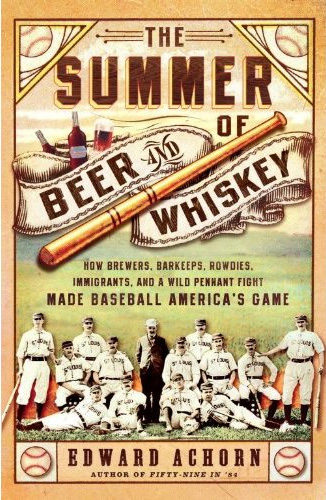
A lot is said today about the tradition and sanctity of baseball. What people tend to forget is that traditionally, the game was played by drunks, brawlers and cheaters. The cheating, in fact, got so bad toward the end of the 1870’s that the American public all but abandoned the game as the major leagues became controlled by bookies and fixed games. Combine that with the lone honest National League pricing the middle class out of games, and baseball, our national pastime, nearly died. Enter a group of ragtag clubs, ran by renegade owners, led by Chris Von Der Ahe, a German immigrant who knew almost nothing about baseball and used his team mostly as an avenue to sell beer, and somehow these guys saved the game. The Summer of Beer and Whiskey by Edward Achorn tells the story of the season of 1883, and how this new league, The American Association, through an unforgettable pennant race, a cast of drunks and outcasts, affordable ticket prices, and all the booze you could want, brought the people back to the stadiums and reignited the passion for baseball.
The action of the story mainly follows Von Der Ahe and Lew Simmons, owners of the St. Louis Browns and Philadelphia Athletics, respectively. Some time is spent with the Cincinnati Reds as well, but the focus remains on the other two. Achorn details the construction of the league and the teams, with a wonderfully nerdy amount of time spent on the personal histories of various players, and then the battles throughout the season and the transactions made to beef up the squads for a pennant run. The Summer of Beer and Whiskey is meticulously researched and written in a mostly unromantic style, and is just as much a history of American city life in the late 19th century as it is a love letter to the national pastime.
This is not one of those history books that “read like a novel.” There is certainly a constant thread and through line, but Achorn isn’t interested in simply entertaining. The book will occasionally go off on tangents that have little to do with the actual season of 1883, like the chapter about the legendary Cap Anson who was not really the great man that we baseball fans grew up thinking he was. He was a vicious racist and was so offended that he had to share a field with a black man, Fleetwood Walker, that he launched a campaign to keep black players out and was almost single-handedly responsible for establishing the color barrier that Jackie Robinson would become famous for breaking more than sixty years later. It’s these asides that breathe life into the book and lend it an air of credibility. It reads like a real history book, relying on direct quotes from players, journalists and owners, as well as directly from press releases and newspaper articles. Achorn is there to provide the prose that turns it into a narrative, but he comes off as much of an observer as we, the readers, do. These aspects can make the read seem a bit dry at times but I personally love that there is no fluffing up of the story in order to create more drama and more romance, just a fascinating look at a game still in its early development.
This book strikes me as incredibly relevant when compared to the criticisms of baseball in today’s world. Steroids, free agency and the mega-contracts it causes, and a perceived coddling of the most expensive players by the clubs seems like a small complaint when compared to fixed games, open racism, and violence against umpires. Still, the core of the game remains unchanged. Sure, there are rule changes and new and improved strategies and methods of talent evaluation, but baseball as a whole remains the same and the passion it creates is every bit as powerful. This book reminds us that it’s not just the tradition that makes us love baseball, but it’s the characters that have populated the fields and grandstands for the last 150 years.

 Some Damn Fool's Thoughts