
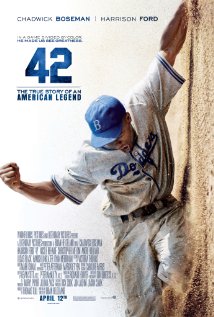
Directed by Brian Helgeland
Starring: Chadwick Boseman, Harrison Ford, Nicole Beharie
Grade: B
Baseball is a game reliant on myth. We look back on figures like Babe Ruth, Sandy Koufax, and Hank Aaron and think of them as something bigger than a simple game played on a dirt and grass diamond. We remember them for the things they might have done, and what they represented, just as much if not more than what they actually did. Jackie Robinson is probably the greatest example of this, and for understandable reason. Most baseball fans can tell you certain facts about players. Babe Ruth hit 60 homeruns in a season, Hank Aaron hit 755 in his career, Koufax threw 4 no-hitters, but I’d venture a guess that a lot of casual fans can’t name statistics about Jackie. They’ll tell you he played for the Dodgers and that he was the first black major leaguer, but what was his batting average? How many homeruns did he hit? These are not questions with important answers in most circles because Robinson was far more than just his stats. He is remembered as a legend, a man who triumphed over something sinister that we created and would love to forget. Jackie Robinson, just by being one of us, makes us all better people. The movie 42 is not a baseball movie in that it’s not concerned with the outcome of games or statistics or anything tangible. It’s a tall tale, using the myth of the first black player as a way to stir the inner romantic of the audience.
42 is advertised as Jackie Robinson’s life story, but it’s not really. It’s about two years in his life. The first year is when he officially joins the Brooklyn Dodgers organization and spends the season in the minors, and the second year is about him breaking the color barrier. An important two years, for sure, but hardly an all-encompassing biopic. Newcomer Chadwick Boseman brings the quiet intensity and inner resolve the legend of Jackie Robinson needs and deserves. He smartly doesn’t oversell it, in fact his performance is probably the only thing even remotely subtle in this film, and because of that he brings credibility to the story.
The story is this: Branch Rickey (Harrison Ford) wants to integrate baseball and he wants the Brooklyn Dodgers, the team he runs, to be the ones to do it. His motivations are deliberately cynical, though in this kind of movie there of course has to be a reveal that he’s not quite so cynical and crotchety as he pretends. Harrison Ford brings his natural crotchetiness to the role and hams it up big time with his curmudgeony Brooklyn accent and big cigars and insane eyebrows. So he wants to integrate baseball, but he needs the right player to do so. Enter Robinson. He’s strong-willed, anti-authority and publicly hates segregation. Plus, he’s really good at baseball. He attends spring training, deals with venomous racism, but makes his mark on the game anyway. His year in Montreal, playing for the Dodgers AAA affiliate is kind of glossed over and quickly arrives at the season where he is promoted to the major leagues. His teammates don’t want to play with him, in fact sign a petition that they refuse to do so, the opposing teams pitchers’ plunk him with pitch after pitch while spewing out vicious slurs at him. He’s only given one moment in which he nearly breaks, such is his resolve, and he is saved by the calming words of Branch Rickey. Because every movie dealing with racism has to have a saintly white character helping the poor black person along. Jackie’s real rock, though, is his wife Rachel (Nicole Beharie) who is always ready to lend him her strength when he falters. In the end, as we’d expect, his teammates, and to a lesser extent the fan base, accept him as one of their own and he becomes the hero we know him as today.
The big criticism of this movie is that it paints in too broad of strokes. It’s more concerned with the legend than the man, and I would agree with that. Though I don’t think that’s unintentional. I believe this movie purposely perpetuates the legend of Jackie Robinson because baseball, and America really, kind of need him to be bigger than life. It took a man better than everyone around him, and not just at swinging a bat, in order to change that old, beautiful game. I’m willing to concede that there is a better Jackie Robinson movie that hasn’t been made yet, one that doesn’t pull any punches and focuses on the truly harrowing journey this man took, over the entire course of his life. Robinson’s story is good enough on its own where it doesn’t really need any embellishment. However, I don’t think the fact that there could be a great movie means this isn’t a good movie. The inner romantic baseball fan in me was sufficiently stirred.
See this movie!
 Some Damn Fool's Thoughts