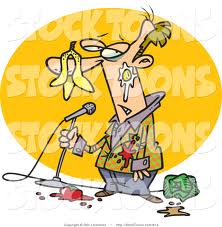
“Alright, I hope you guys are having a great time tonight. Next on stage is a very funny man, performed here a lot, Danny Cerullo.”
Okay, here we go. Grab my drink, no leave it. I’m not Dean Martin. That’s actually kind of funny, maybe I should use it some time.
“And Danny’s wearing an awesome Iron Maiden shirt tonight.”
Smile. She’s joking with me. I wonder if she’d bang me. Shit, I’m on stage, shaking her hand, think of something witty. I’m terrible at this off the cuff shit.
“I figured just in case my set didn’t repel all the ladies in the audience, then my shirt would.”
They’re laughing. That wasn’t bad, wasn’t great.
“Speaking of ladies, a doctor told me recently…” Doctor? What the fuck? Why would I say a doctor? Who in this audience is even going to believe I know a doctor, much less had a conversation with him? …”That lactating women can sometimes shoot milk out of their nipples during an orgasm.” Pause. Let them absorb it. “I call bullshit on that one. Girls can’t have orgasms.” God that joke’s easy. Still, it got a laugh. Good way to break the ice. It’s so dumb though. And seriously what the fuck was that part about talking to a doctor? What, am I trying to lend the stupid orgasm joke an air of credibility?
“Anyway, thanks for coming tonight. Like Amanda said, my name’s Danny.” Nobody cares, get to the funny. “And long before I became the awkward man you see before you tonight, I was an awkward child.” I really don’t need to emphasize awkward so much, they probably get that. “I used to play little league baseball. Anybody here play little league? Blatant pandering. I’m a sell out. “My dad was more into it than I was and I really wasn’t very good. When I got to high school, I clearly wasn’t good enough to make that team. Christ, this is dragging. The punch line isn’t even very funny. “So my dad just kept signing me up for little league.” Pause for laugh. Who am I kidding? “I tell you, I might not have been able to outhit the little shits, but I sure as hell could out drink ‘em.” Hand on forehead, look miserable. That’s not very hard. “God, there’s nothing worse than being struck out by a ten year old. Except when you cry when he hits you with the pitch.” Okay, my awkwardness has drawn them in. If I’m pitiful enough, I become endearing. Story time. “Little league wasn’t all bad though. I can remember walking up to the batters box. It’s a beautiful day outside, my team’s winning and the poetry of the game is in full swing. The sense of camaraderie is unlike anything I’ve ever experienced. I strike out, but it’s okay, who cares, everything’s perfect. I smile, turn around and head back to my dugout. I see my father standing behind the backstop. He says: Shout the line. Make it powerful. “Stop smiling you just struck out!” Ah, they’re laughing good now. Nothing like mean fathers for comedy. “I should point out that my father wasn’t hard on me because he thought with more effort I could be a great baseball player, or that it would build character and teach me valuable life lessons. He just didn’t love me.” God, I’m a bad son. My poor father works his ass off every day so I can have a decent childhood and I shit on the guy in front of a crowd of drunks. Oh well, it got a good laugh I guess. He’ll understand.
“I was reading an almanac the other day.” An almanac? I’ve never read a fucking Almanac in my life. I’m not really even sure what an Almanac is. “And I learned that sea otters are the only animals, other than humans, that can contract genital herpes. Which made me sad, you know?” Here comes the world’s easiest punch line. “I’m not fucking any more of those.” God that joke sucks. It’s seriously the stupidest joke ever written. Aaron wrote it though, and he’s dead so that makes me a good person for keeping his joke alive. Shit, I think Josh wrote it. If I’m up here telling jokes Josh wrote I need to rethink my entire life, much less my set.
Alright, here’s my big closer, don’t blow it. “Believe it or not, sometimes I get a little lonely.” Not sure if I should be happy or depressed at how big a laugh that got. “So the other day I called a phone sex line, which right off the bat is a terrible idea because I’m not much of a talker during sex. The worst part is, these girls always ask ‘What do you want me to do to you?’ And the thing is, maybe I’m just not imaginative or maybe I’m just vanilla, but I don’t need anything special. Whatever it is you normally do, I’m sure it will be fine. So then she asks me what I’m wearing.
‘Sweatpants and an old T-shirt,’ I say.
‘Ooh, did you just get done working out?’
‘No, I just woke up.’
‘It’s three o’clock in the afternoon.’
‘Yeah well, I had a long night.’
‘And what were you doing? Something hot, I bet.’
‘Totally. Hall and Oates reunion concert.’ I’m probably the only comic working right now that would drop a Hall and Oates reference in a joke. I might suck, but at least I’m original. “After a few minutes of extremely awkward phone sex, I think she just started to feel bad for me.” Much as you people seem to. “Because she started giving me life advice.” Now it’s time to dial it up. Breathe heavily, do my sexy-phone sex-girl voice. They’ll never see it coming from a guy like me. “Oh baby, maybe you should take that big old cock of yours and go back to college.” Now that’s a genuine laugh. I believe I even heard somebody shriek. “And maybe you can show what a big sexy man you are and stop blaming all your life’s problems on your mother.” That would probably be a lot funnier if I was Jewish. Every Jewish comic has serious mom issues. But hey, maybe they think I’m Jewish. Maybe I should change my name to Danny Cerulberg. “I started to feel really close to this woman. She told me that this wasn’t her real job, that she was really an actress. Me being an aspiring comedian, we shared a good laugh over the irony.” Here it comes, milk it. “And then I came all over myself.” Pause again. They’re loving it. They find my shame, loneliness and humiliation hilarious. I’m a genius! “The whole thing cost me eighty-seven dollars. Thank you, you’ve been a great audience.” Wave once, walk off stage. Shake Amanda’s hand on the way down. I hope somebody buys me a drink, I’m broke.
Month: April 2013
The Mirage by Matt Ruff
Grade: C
At this point, September 11th stories have practically become their own genre. We have Sci-Fi, Horror, Mystery, Appalachaian Lesbian, and 9/11 stories. The idea, I suppose, is that those attacks will conjure up enough emotional memory in the audience that the impact of the story will be that much greater. It’s a pretty cheap tactic, one that I can’t think of a single instance where it felt honest and not manipulative. Matt Ruff uses this new genre, along with the tried and tested Sci-Fi branch off The Alternate Universe, in his novel The Mirage.
In this novel, the alternate reality is that on November 9th (get it? 11/9?) a group of Christian extremists from the third world region of America hijack some planes and fly them into the twin towers of the United Arab States. Basically, the same thing happens, in reverse though, as happened in real life. The United Arab States declares a war on terror and bombs the shit out of America and frees them from their vicious tyrant, though all their efforts don’t really seem to stop the terrorist attacks, or make the war-torn region any safer. There are three main characters: Mustafa, the morally conflicted one who senses something is amiss about his world, Samir, the closeted homosexual, and Amal, the tough woman playing in a man’s world. Sound familiar? That’s because those are character tropes used in nearly every spy thriller ever written.
Anyway, those characters aren’t important. The ones the reader will flock to are Osama Bin Laden, Saddam Hussein, an unnamed but very clearly Dick Cheney, and a bunch of other people from our reality. What could have been fun about this world would be to make well known villains, like those listed above, into something heroic, or at least a conflicted source of good. Unfortunately Ruff is not interested in that. “A wicked prince in one world is a wicked prince in all worlds” is the sentiment used to justify keeping the villains as villains, and to be fair there is a plot reveal that justifies it dramatically as well. Still, I suspect the real reason is that the author, and maybe the publisher, doesn’t think the American public can tolerate Hussein or Bin Laden as anything but monsters. It feels like an opportunity for genuine and clever satire gone completely to waste.
I don’t mean to completely shit on this book though. It’s a perfectly serviceable espionage thriller, with a pretty exciting plot and well-written action. The characters may be a bit incomplete and feel like caricature at times, but that’s pretty true of the genre as a whole. The plot twists and battle scenes are what’s important in these works, not deep character insights. If it didn’t use 9/11 as a cheap way to add meaning to an otherwise perfectly fine, if unremarkable, story, I would probably grade it a bit higher. As it is, I’m not sure what this book has to say about the turmoil the world has been over the past decade-plus that hasn’t already been said. It doesn’t bring anything new to the conversation, it just makes us go “Oh, that’s George Bush they’re talking about!” Or “Holy shit, is that really Timothy McVeigh?” Merely employing the existence of these characters isn’t enough to tell a impactful story with them.
Please don’t read anything political into this review, or this book for that matter. This novel is neither Liberal propaganda, nor Conservative. Ruff is equally critical of both sides and never loses his sense of hope for a possible future. This story ends ambiguously, but optimistic in its way. Those looking for political, cultural, or philosophical insights will find it lacking. But those looking for some glimmer of hope through the shit cloud of crippling despair fed to us through the media outlets and the politicians we keep electing for some reason, might just find a reason to maintain some shred of hope in humanity.
Prometheus
Directed by Ridley Scott
Starring: Noomi Rapace, Michael Fassbender, Charlize Theron
Grade: C-
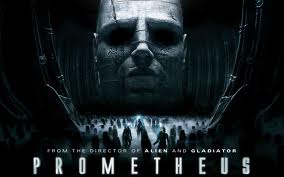
Prometheus is an underwhelming, conventional, two hour sci-fi film that exists solely for a thirty second scene at the end to make fan boys say “Oh, so that’s where Alien comes from! Cool!” This of course speaks to the problem of any film franchise, and that is being overly self-referential. Remember how in the Star Wars prequels they couldn’t stop reminding you, as heavy handed as possible, about the old movies? Aside from the shitty story, hollow dialogue, empty characters, awful directing, and wooden acting, it was the single worst part of those films. I don’t go to see new Terminator movies because I hope Schwarzenegger will pop up and say “I’ll be back,” I go because I want to see robots killing people, and people blowing up robots. Likewise, I don’t care if Prometheus is a prequel to Alien or not, I just want it to be a good movie where people I’ve grown to care about in some capacity die in really horrible and interesting ways. Is that so much to ask?
The story is this: Some scientists find a bunch of cave paintings in various parts of the world that are all kind of the same. They seem to hint that there is this cluster of planets and there are beings there that probably created us. How the scientists determine this is not really explained. Also, this is in the future so they can travel there and check it out for themselves. The android David (Michael Fassbender) watches over the badly assembled team as they sleep over the course of a two year long flight. I say badly assembled because it doesn’t really make much sense to embark on a mission of this magnitude that takes this much knowledge and skill, and not make sure in advance that the people involved like each other and can work together. Anyway, they get there and the place is a tomb. It turns out the aliens were building some weapons of mass destruction (ooh, political!) and killed themselves. This team of scientists and geologists and a security guy that nobody listens to, don’t get along at all and make really poor choices that leads to many unnecessary deaths. The corporation that funded the trip is represented on the journey by Meredith Vickers (Charlize Theron), who’s a real bitch for some reason, and at one point has sex with the pilot just to prove that she’s not an android like David.
Bubbling beneath the surface, Prometheus seems to want to wrestle with large questions, as any good sci-fi story should, questions about the nature of humanity, our capacity for destruction and our equal capacity for love, and whether we’ve squandered this gift of life or are just beginning to harness it. But ultimately, none of those questions add up to anything. We just get a monster movie where the monster isn’t even cool. Then at the end there’s some big, body-builder alien that wants to kill everybody, and never explains why. This isn’t being awesomely deceptive and ambiguous, it’s just a copout.
Ridley Scott has made far more bad and mediocre movies than great ones at this point in his career and is quickly losing his status as a “must see” director. I’m not saying Prometheus had to be some jaw-dropping, shake my entire worldview kind of movie, but it could’ve at least been fun and entertaining and maybe even a little bit terrifying. The worst thing a movie like this can ever do is be boring. A great deal of the running time, I was just hoping somebody else would hurry up and die. That’s probably not a sign of a great movie.
Buy this movie!
http://www.cduniverse.com/productinfo.asp?pid=8745615&style=movie&frm=lk_Somedamnfool
42
Directed by Brian Helgeland
Starring: Chadwick Boseman, Harrison Ford, Nicole Beharie
Grade: B
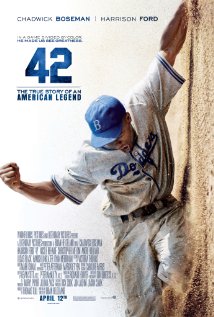
Baseball is a game reliant on myth. We look back on figures like Babe Ruth, Sandy Koufax, and Hank Aaron and think of them as something bigger than a simple game played on a dirt and grass diamond. We remember them for the things they might have done, and what they represented, just as much if not more than what they actually did. Jackie Robinson is probably the greatest example of this, and for understandable reason. Most baseball fans can tell you certain facts about players. Babe Ruth hit 60 homeruns in a season, Hank Aaron hit 755 in his career, Koufax threw 4 no-hitters, but I’d venture a guess that a lot of casual fans can’t name statistics about Jackie. They’ll tell you he played for the Dodgers and that he was the first black major leaguer, but what was his batting average? How many homeruns did he hit? These are not questions with important answers in most circles because Robinson was far more than just his stats. He is remembered as a legend, a man who triumphed over something sinister that we created and would love to forget. Jackie Robinson, just by being one of us, makes us all better people. The movie 42 is not a baseball movie in that it’s not concerned with the outcome of games or statistics or anything tangible. It’s a tall tale, using the myth of the first black player as a way to stir the inner romantic of the audience.
42 is advertised as Jackie Robinson’s life story, but it’s not really. It’s about two years in his life. The first year is when he officially joins the Brooklyn Dodgers organization and spends the season in the minors, and the second year is about him breaking the color barrier. An important two years, for sure, but hardly an all-encompassing biopic. Newcomer Chadwick Boseman brings the quiet intensity and inner resolve the legend of Jackie Robinson needs and deserves. He smartly doesn’t oversell it, in fact his performance is probably the only thing even remotely subtle in this film, and because of that he brings credibility to the story.
The story is this: Branch Rickey (Harrison Ford) wants to integrate baseball and he wants the Brooklyn Dodgers, the team he runs, to be the ones to do it. His motivations are deliberately cynical, though in this kind of movie there of course has to be a reveal that he’s not quite so cynical and crotchety as he pretends. Harrison Ford brings his natural crotchetiness to the role and hams it up big time with his curmudgeony Brooklyn accent and big cigars and insane eyebrows. So he wants to integrate baseball, but he needs the right player to do so. Enter Robinson. He’s strong-willed, anti-authority and publicly hates segregation. Plus, he’s really good at baseball. He attends spring training, deals with venomous racism, but makes his mark on the game anyway. His year in Montreal, playing for the Dodgers AAA affiliate is kind of glossed over and quickly arrives at the season where he is promoted to the major leagues. His teammates don’t want to play with him, in fact sign a petition that they refuse to do so, the opposing teams pitchers’ plunk him with pitch after pitch while spewing out vicious slurs at him. He’s only given one moment in which he nearly breaks, such is his resolve, and he is saved by the calming words of Branch Rickey. Because every movie dealing with racism has to have a saintly white character helping the poor black person along. Jackie’s real rock, though, is his wife Rachel (Nicole Beharie) who is always ready to lend him her strength when he falters. In the end, as we’d expect, his teammates, and to a lesser extent the fan base, accept him as one of their own and he becomes the hero we know him as today.
The big criticism of this movie is that it paints in too broad of strokes. It’s more concerned with the legend than the man, and I would agree with that. Though I don’t think that’s unintentional. I believe this movie purposely perpetuates the legend of Jackie Robinson because baseball, and America really, kind of need him to be bigger than life. It took a man better than everyone around him, and not just at swinging a bat, in order to change that old, beautiful game. I’m willing to concede that there is a better Jackie Robinson movie that hasn’t been made yet, one that doesn’t pull any punches and focuses on the truly harrowing journey this man took, over the entire course of his life. Robinson’s story is good enough on its own where it doesn’t really need any embellishment. However, I don’t think the fact that there could be a great movie means this isn’t a good movie. The inner romantic baseball fan in me was sufficiently stirred.
See this movie!
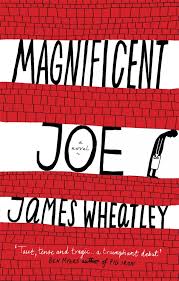
Magnificent Joe by James Wheatley
Grade: A-
Centering a novel’s or a movie’s action around a mentally challenged person is inherently dangerous territory. The story quickly turns into Radio or something similar, that is to say overly simplistic sentimental bullshit meant to pull on heart strings and manipulate its way into relevancy. The lesson is, you see, that this “slow” human being is really the wisest sage among us and exists for the sole reason of teaching us all valuable lessons on life and allows us a glimpse, for once, into our own humanity. These selfless beings are our guardian angels, not actual, fully realized people with their own fears and ambitions and dreams and desires. Nope, the mentally challenged are normally relegated to the same proverbial corner that the Magical Negro has been stuck in since, well forever more or less. I bring this up because Magnificent Joe by James Wheatley, refreshingly, doesn’t do that. Joe is a fifty year old man with learning difficulties and that’s who he stays as for the entire book. He doesn’t suddenly break out of character to deliver key advice at a crucial time. He’s stuck in his own rut, that is in the process of being destroyed, the same as all the other characters in the novel. They’re all of them limited in life, Joe’s just another number among them.
The narrator, with the exception of a few chapters told in the third person, is Jim. Jim spent most of his teenage years and the first few of his adult years locked up for killing another kid in a fight. It wasn’t an intentional thing, just a lucky, or unlucky, punch that he landed. When he gets out he goes back to the same small town he grew up in, his family all dead, and is taken in by his old friends. With no options for an ex-con, he goes to work in construction with his buddies and ekes out a meager existence. In some vain attempt to atone for his sins, he takes up his father’s old role of caring for Mrs. Joe, an old widow and the mother of the title character. He lives basically in squalor, spending all his available cash on booze and spends most of his free time at the pub with his friends, Barry and Geoff. Through carefully guarded secrets, betrayal of friends, and an impactful death, the small town becomes even smaller, more restrictive and far more dangerous. The story exists for Jim to be redeemed, more or less, but it doesn’t let him off easy. Wheatley is perfectly content dragging this man through every gutter he can find, destroying him physically, mentally, spiritually and emotionally, until Jim is a broken man and has a chance to be rebuilt.
Written in stripped down, unpretentious language, Magnificent Joe feels authentic. Wheatley’s ear for dialogue is damn near pitch-perfect and his prose doesn’t waste time on flowery descriptions or rambling, abstract interior monologues. The only real flaw in this novel is that the end feels a bit rushed. It’s not exactly easy, but it wraps everything up very quickly. I greatly appreciate short novels and find the longer ones to be a little off-putting, but these characters are complex and enjoyable enough to warrant spending another 20 pages or so with them. The last chapter in particular feels very much tacked on just so we can get some semblance of a happy ending. In a novel that avoids the cliché very well throughout, for it to succumb to a tried and true, and a bit trite, image to end on was a bit insulting. Still, this is a very solid debut and worthy of a read. Wheatley’s a strong new voice and a talent that should definitely be watched.